Tuesday, January 15, 2013

brave on the page at powell's city of books

Every Portland writer dreams of reading at Powell's City of Books - not to mention plenty of writers across the country. What a cliché to say, but it's true. I had the chance to be part of an event there in 2009 when Portland Noir came out. Though I wasn't one of the readers, I got to hang out at the table and sign books afterward, as a contributor to the collection, and it was definitely one of the thrills of my writing life.

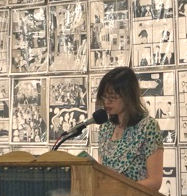
Last Monday, January 7th, I read at that podium as part of the Powell's event for the book Brave on the Page. It was an incredible event in many ways. The lineup was...wow. Reading from their essays in the book, along with me, were Kate Gray [Another Sunset We Survive], Gina Ochsner [The Necessary Grace to Fall], Robert Hill [author of When All is Said and Done and a personal writing hero of mine] and writer / editor / publisher / powerhouse Laura Stanfill. After the readings, writing guru Joanna Rose [Little Miss Strange] moderated a panel on writing, process and creativity with Jon Bell [On Mount Hood], Kristy Athens [Get Your Pitchfork On], Scott Sparling [Wire to Wire] and Yuvi Zalkow [A Brilliant Novel in the Works].

Jon - Robert - Scott - Kristy - Laura - me - Joanna - Yuvi


When we gathered for a photo afterwards, Kate and Gina were lost in the crowd and we couldn't pull them over, but here's most of us - framed by a wall of black and white comic book pages. When you think about reading in the Basil Hallward Gallery in the Pearl Room of the City of Books, you have to wonder what art show will serve as your backdrop. I loved this. It was nearly floor to ceiling.

Robert Hill

We had a wonderful, enthusiastic crowd of approximately 150 people, including local writing luminaries like Tom Spanbauer, Stevan Allred, the recently-Oregon-Book-Award-nominated Carter Sickels. And one of the coolest things to me: so much of this crowd was writers. I suppose that's to be expected when the book is about writing and the essays speak to the writing life and the panel is all about craft - but as expected as it was, it still made me very pleased, so many of us gathered in one place to talk about this thing that is sacred to us.


Kate Gray
I really liked the mix of essays chosen for the event. Kate Gray's "Shiny Object, Shiny Object" was full of great suggestions for writing and getting the job done, all of which I [wish I could] adhere to. "...After an hour on a bike, the focus on one-foot-two-feet, spin-spin-spin, everything else falls away. And I am balance and shift and friction..."

Gina Ochsner
Gina Ochsner spoke about the very particular issue of cynicism and what it can do to our confidence, our writing process. "...If I allow cynicism to drum with the heavy hammers of no good, no good against the tympanic membrane, I hear the winter wren in the dark hemlock behind our house. I can't recognize the beauty of its song nor appreciate the fact that the smallest, plainest birds compose the sweetest songs..."

me
Again, it was a nice mix - because Kate and Gina's essays spoke about process and craft, Robert Hill and Laura Stanfill's essays combined writing topics with personal stories, and mine was a purely personal story - one that, when I lived it, had been full of shame and, when I read it last Monday, got a surprising amount of laughs from the audience. I love when the stories of your life do that:

"...Ring of the phone, his voice in my hear, high, almost feminine: 'Can I share something?'

"It wasn't really sharing since he'd only called to read me a story he'd written, and he didn't really want to know what I thought unless I loved it.

"Sometimes I didn't, but I hated to disappoint people..."

Robert's "Why I Write Out Loud" is about words - about sound and texture and cadence - but is also about family. "...I grew up on stories told at bedtime, told on car trips, told at the dinner table, after dessert. My mother told these stories, five or six of them, over and over, in rotation..." and "...Every syllable of these words told in my mother's raconteur's voice full of wit and Brooklyn inflection I loved hearing, every entertaining sentence told again made the usual silence of our family bearable..."

Laura Stanfill
Laura Stanfill's "Overnight" describes the writer / mother dilemma, Laura lying in bed, waiting for her daughter to fall asleep so she can get up and write her novel. But this tiny essay is so much more:

"...The boy in my novel gets diagnosed with a weak constitution, and he believes what the doctor says. He stays in bed. He reads and rests. He wishes. My daughter rolls over, tilts her chin up, breathes deep. She started kindergarten this fall. The shift of her world has begun. Someday both my girls will leave the house without me. They will be broken apart by small things. I tell stories about brushing teeth, drinking milk, getting enough sleep, instead of filling pages with lace and music. Someday my girls will choose whether or not to be good to their bodies..."

Joanna Rose
Sadly, I can't include a bit of voice from Scott, Yuvi, Jon or Kristy, since their portion of the event was all off the cuff, not in any book for me to refer to. But it was such a terrific panel. Funny, fascinating, just the right length. Joanna Rose led them through such topics as dealing with holes in writing, "fact vs. truth," and the benefit of writing groups - illustrated perfectly in a story Joanna told in which, while workshopping a scene with the Pinewood Table writing group, Scott Sparling learned that women in showers do not squat to pee.

Kristy Athens - Jon Bell - Scott Sparling - Yuvi Zalkow

These guys were great. Every one of them. And after the formal panel, Laura brought all of us back up front for a Q&A, taking questions from the crowd.


- A little goofing with the mic, which didn't quite reach me in the very center of the group. It was an honor to sit in the middle of these smart writers and try to keep up with the great questions and answers.

I said it was an incredible event in many ways, and another of those is the support Brave on the Page has had from Powell's. Forest Avenue Press is a very new press, a micro-press, yet here we were with a big event hosted by the City of Books. Also, the  books are printed just one floor down on the Espresso Book Machine. I think Laura Stanfill has something really special going with Forest Avenue Press, and the support she's gotten says loads about not only Powell's and the writing community in Portland but also - and most of all - Laura's energy, ingenuity, and smarts.

Laura Stanfill
After it was all out and over, Laura had this to say in an e-mail of thanks to all the participants:

"I keep thinking about reading in the Pearl Room as a dream come true and how it came true in a richer, deeper, more powerful way than I could have imagined. And nobody in New York made it happen, no agent or editor or outside party. We made it happen. Together." 

*

To order Brave on the Page from Powell's Books, click here.

To check out Forest Avenue Press, go here.

FAP is now accepting submissions from Oregon authors writing "quiet novels." To submit, click here.

Thursday, December 20, 2012

found poetry in paper globes


In part to decorate for the holidays, in part to celebrate our 41st anniversary, Powell's decided, this year, to create some lovely art installations of hanging paper globes cut from the pages of damaged books.

The idea and most of the legwork and artistic work came from Lenore Ooyevaar, our graphic designer. I helped out by doing some coordinating with the stores, cutting some paper circles for the prototypes, and finally helping install.

You wouldn't think sitting around unfolding hundreds of paper globes would be fun, but I enjoyed the company of some great gals in Powells' Marketing Department, plus, one afternoon, a customer actually asked if she could help. What I loved the most, though, was all the found poetry inside these paper globes. Snippets of text, photos, old book illustrations. There was something new and beautiful and weird and quirky with every page I unfolded:

“…Cordelia and the depths of solitude…”

"...Twelve good men and true..."

The complete nutritional breakdown of "Graham cracker panda."

This creature...


An art book that shows how to take the pictures of 12 Hollywood actors, including Franchot Tone, George Brent and Robert Montgomery, and combine them to make, "...this charming young man—albeit a trifle effeminate..."

Molecular diagrams plus the naughty edge of Michelangelo's David...


Two different book pages meeting across the center break to take two fragments and turn them into one perfect [or perfectly awful] sentence. A spiritual book and a medical book: "I am filled with devine … mucus."

[sorry.]

Lists of artists on the right, bodybuilders on the left:


“...Narcissists make the best leaders...”

These cute cartoon illustrations in a book of, I believe, Jewish history:


I think this second one was at the bottom of the title page.


Found poetry in the table of contents of Vivilore, a book on marriage, beauty, sex, fashion, childbirth and motherhood, first published in 1904: "...An Endless, Widening Stream — The Ennobling Art — A Co-Laborer with the Divine — Intelligent Breeding of Animals — Shall Humanity be Left Behind?..."

Monday, December 17, 2012

being brave on the page with sarah cypher


I've met [in person and cyberly] some really great writers through my involvement in Laura Stanfill's book Brave on the Page. One of them is writer / editor Sarah Cypher, of the Threepenny Editor.

After Laura introduced us via e-mail we started a bit of an e-conversation that grew and spilled out over a few months. We're very different writers. She excels at speculative fiction; I like to stick close to my own life for inspiration. She puts lots of planning into a project before she starts writing; I... don't. Sarah is full of great writing wisdom, as her interview in Brave on the Page can attest, and our e-mail thread has started to feel like a companion piece to that book. Here's some of what Sarah has to say.


The big picture vs. language in writing interests me, and I don't really have a rule for it. I'm reading Blood Meridian right now, and Cormac McCarthy is so much about the language - the novels would be hollow if the narrator did anything less than put the weight of the universe on our shoulders. Yet on the other hand, I see manuscripts that give so much loving attention to the language, but it doesn't deepen the story. There's some X factor that makes language and story click together in one novel, and in another, not.

and...

What I try to do in fiction is set up an idea, a what-if that is compelling enough to engage the reader and get him/her listening hard between the lines. If a reader isn't willing to listen for what isn't said, then it's hard for a story with any kind of subtlety at all to work.

Process is a very individual thing. Mine tends to be pretty fluid and unplanned, with the best of my writing often coming from something quirky that pops off the top of my head. I was interested in hearing more of Sarah's process, especially since she is not only a fiction writer but an accomplished editor of others' work.

My process probably errs too much on the side of planning, but it's been helpful nonetheless. Speculative fiction, as a really broad genre, gives me a chance to pick and choose disparate elements from the world, ones that resonate for whatever reason in my imagination. Then I spend a long time guessing at why, and trying on a bunch of conflicts that might tease out that same resonance in a good plot. 

For instance, I've been looking at cyberwar, natural disasters, and gender identity for a next novel - huge topics that suggest a dozen different kinds of conflicts. There's a mysterious, crooked note that runs through them in my mind, and I've done a lot of reading and research to figure it out and capture what's human and emotional in it. It's the listening phase at the beginning of a new project, and it usually ends up being the emotional chord that I try to hit in the story's big, turning-point scenes. 

Then I've got a whole plotting system that works 50 percent of the time, and it helps me cobble together an outline that I sometimes follow, sometimes tear up.

Sarah's having a plotting system really intrigued me. Do most writers have systems they follow? Probably many do. My system is to write down some quirky thought that came into my head and amused or intrigued me and then just start writing and see where it goes. Lots of tearing up happens in that system, too, but it happens along the way of the story. Which system takes longer? Which system makes for a better finished product? I think it depends on the brain. I have a hard time wrapping my brain around story if I'm not wrapped up inside the story and inside the voice of the narrator. When I do try to plan beforehand, I feel like I'm running underwater. I don't really get anywhere until I give that up and start writing.

I'm a visual thinker, so I like to see my arc, my scenes, my subplots, and my theme. I also run my ideas through Lajos Egri's premise / protagonist / antagonist system [The Art of Dramatic Writing], and the young adult tool for identifying your hero's controlling belief. Sometimes I think about Joseph Campbell [The Hero's Journey]. They're all ways of panning for gold. Sometimes, though, I'm like you: I just write to the best of my ability and see where the words find depth, and follow that. It's definitely the scariest exercise.

You wouldn't think of writing as a scary thing. When editor Laura Stanfill first floated Brave on the Page as an idea for the title of her book on writing, my thought was, yes, writing is a place where you can be brave. You might have been that kid who ate lunch in the library and ran away from the volleyball [perhaps I've admitted too much, here], but alone and safe with a page and a pen, you can be brave. The more I thought about it, though, I realized you can take that phrase, brave on the page, a number of ways. Sometimes the being brave isn't what you can do but what you must make a concerted effort to do. In our e-conversation, Sarah and I found ourselves talking a lot about this.

To me, being brave is just a test of faith: that your idea matters, that your story matters, that your intuition is alive. I do a lot of planning at the outset, but it is helpful only so far - usually as a trail of breadcrumbs to follow if I lose my way. It's also a way of helping knit research together. I almost always change the plan as I'm writing, but the goal is to do it from a position of creative confidence, an informed discovery that I was wrong about something, and that my character is developing well enough to point it out to me. Otherwise, I just feel like I'm blowing with the wind, and that eats away at my courage.

Bravery in writing comes in looking at that blank page and finding something to say. Bravery in writing comes in creating something and hoping to god it's good. It comes in opening up one's secrets, one's sore spots. It comes in spending hours and weeks and months and sometimes years on a project and knowing that what lies ahead is a string of rejection letters. It comes in choosing a plan and sticking with it even though it's so hard to know what will yield the best results:

Plotting everything out beforehand can clear some likely territory, but for the most part, now that I've just thrown myself into writing a huge chunk of this current novel by intuition alone, the fear of the unknown scenes ahead corners me sometimes - I don't want to waste months working on scenes that don't work. But when I compare that to the fear of being no good at all, the fear of wasting my time and my hope, the fear of where the story is going seems positive - a challenge, rather than a put-down.

I think that's the key, really. Finding the fear that's the most positive, the most productive, and sticking with it.

*

Check out Sarah  Cypher's blog here - and the Threepenny Editor  here.

You can buy Brave on the Page here on Powell's.com

Sarah wrote her own blog post in response to our conversation, and you can read it here

Sunday, December 9, 2012

christmas revels

I've wanted to go to a Portland Revels show for a while, now. A great lady I know has been involved with the group for years and yet I've never made it down there. Well, this week, I scored myself some tickets to their winter show, the Christmas Revels, and had myself a very nice evening, out at the beautiful old Scottish Rite building in downtown Portland.
The Christmas Revels is like that old tradition where carolers come to your home and sing, except that in this case, you're invited into their home. And asked to stay a while. What I like the most about it, though, is the historical aspect. Each year, they pick a new time and place from which to regale you. This year, it's nineteenth century Appalachia - my old stomping grounds. Kind of. Not the nineteenth century part, but a lot of my kith and kin came from or settled in Appalachia. Kind of. Maysville, Kentucky, where my Dad grew up and Cross Junction, Virginia, where I used to go visit my grandparents, are right at the edge of the purple on the map, so close that I can't tell whether they're officially in or out. But still. I'm claiming it.

You can't help but want to claim that area when you're treated to lovely banjo and fiddle music and even clog dancing. The music was by the Blue Mountain String Band, and it was loads of fun. One member of the band, Leela Grace, who played banjo, was one of the cloggers as well. The show also featured the Portland Brass Quintet, a troupe of mummers, sword dancers and a huge chorus of singers.

I love harmony and choral music, so the back and forth between that and the string band was really a treat. Lovely, lovely singing. Some highlights of the show for me...

~Soloist Suzannah Park singing the old traditional version of the hymn "Guide Me, O Thou Great Jehovah" in a beautifully ornamented style that the program says comes from eastern Kentucky's oral tradition.

~Nedra Schnoor Egan playing the possum in the theatrical staging of the Native American story of how light was brought into the world.

~Suzannah Park and Leela Grace's duet of Say Darlin' Say.

~Clog dancing, you guys!

~Ithica Tell. Every place she appeared in the program. She was wonderful and dynamic.

There was also one song performed by the big choral group that particularly knocked my socks off, and I have no idea what it was anymore. So much of the music, I'd never heard before, so I couldn't hold onto it. Shaker hymns and shape note songs and Appalachian tunes. But I have a nice, little printed program full of interesting, historical info on all the different offerings of the evening, so I can learn more, which I love.

Square Dance

The Christmas Revels is playing through December 16. You can check out showtimes and get more info here.

Friday, November 30, 2012

profiling lives

When I started work this summer on the two eBooks I wrote for Publishing 101's Careers series, I had to interview and profile a number of different people in each of the two careers I chose.  I had a routine all worked out for this, most of which consisted of a nervous stomach and semi-suicidal thoughts for the whole day before the interview, every time. Once I got on the phone, though, I was surprised by the experience.

First, I calmed down and relaxed by about five minutes into the conversation. Every time. [Except maybe for the first time. Which I wrote about here.] You'd think that would make things easier on subsequent attempts, but alas.

And second, I sort of fell in love.

Every time.

You can hear it in the recordings I made of each interview. I'm like a fourteen year old goo-gooing into the phone while writing a boy's name over and over on my Pee Chee folder.

The aim of the career eBooks series is to help people research, choose and move toward a profession, and the profiles are mainly intended to give a well-rounded sense of the job. But careers often define us. While I interviewed these people, I wasn’t just learning what it’s like to be an accountant or a glazier [that’s a glass-worker, someone who installs windows]. I was being given the distilled story of a person’s life. Every time. When you’re given so much of someone’s life, how can you not fall in love a little?

With the longtime journeyman glazier musing on the days before safety regulations: "Used to be a lot of the old timers were missing a finger or something. It’s so long ago that I don’t even think twice about it now, but when I first got into the trade, the first time I was holding a twelve foot long piece of glass, well, I was kind of a little nervous."

With the young glazier who described her trip to Wisconsin to represent her union during the fight for collective bargaining rights last year: “I have goose bumps right now, telling you this. I used to joke that I should have been born in an earlier time — to experience the sixties, with all the war going on, the protests — I always felt that was such a big moment in our recent history. Now I realize I do belong here.”

With the apprentice accountant who didn't like to see tax season come to an end: “You’ve just had four months where you’re crazy, coming into the office all day, every day and working your butt off to get it done. And then the day after, you walk into the office, and there’s nothing to do. That’s what I hate the most. The day after tax season.”

With the CPA who, as a child, probably could have seen his career choice coming a mile away: "I have a picture of me when I was six years old, and I’ve got a pocket protector with pencils in it."

 My subjects were ambitious entrepreneurs or starstruck dreamers or hitchhiking hippies. They were confident and expansive or cautious and abrupt or merry and nostalgic or cocky and naive. I fell in love with them all. I was gathering details for a book on what it is to be an accountant or what it is to be a glazier, but it surprised me how easily it turned into what it is to be human.

*

By the way, if you want to, you can check out my eBooks here:

Glaziers: Stories From People Who've Done It
Accountants: Stories From People Who've Done It

Or on the eBooks page on my website here.

Sunday, November 25, 2012

burnt tongue 2 - a wrap-up

domi rocking a very burnt-tongue-like hairdo.
photo courtesy of kathy mcferrin
Writer, organizer and all-around powerhouse boi-about-town Domi Shoemaker put on a hell of a show last night at Crush Bar in Portland. Burnt Tongue 2 was the second in a quarterly series of readings created to honor Tom Spanbauer, author of four books and creator of Dangerous Writing. Emcees Doug Chase and [my husband] Stephen presided over a packed house, and in the lineup were current and former Dangerous Writers along with some special guests. I thought I'd try to give you a little snippet of thought about each.

Chloe Caldwell was up first with one of my favorite essays from her book Legs Get Led Astray. "My Mother Wanted to be Betty Boop" is a beautiful list poem about her mother - and ultimately about longing. I already loved this piece after having read the book, but last night, given that foreknowledge and given the pace of Chloe's reading, I was able to linger a little longer over each thing Chloe told us her mother wanted - so that when she came to the line "My mother: taking off her bra underneath her shirt when she came home from work, and saying that it was the best part of her day," my reaction surprised me. The line is funny and brought a chuckle from the audience, but underneath that is a realness and simple heartbreak that brought tears to my eyes.

photo courtesy of lidia yuknavitch

From motherhood, we shifted to the topic of chlamydia with a chapter from Colin Farstad's novel The Four Month  Summer. Down in Tom's basement during Thursday afternoon Dangerous Writing workshops, I've heard Colin read many different incarnations of many different parts of this book. And, as Stephen mentioned in his intro, I've even listened to Colin read the book in its entirety at a lovely salon. So, I have plenty of context for what he read, but for Burnt Tongue 2, Colin did some masterful editing to turn the chapter into a painfully hilarious stand-alone piece.

photo courtesy of kevin meyer

Then John Hinds took us out of the men's room and into a jungle night laced with psychedelics in his short story "The Cosmic Raven of Enlightenment." I've always loved John's easy style as he writes about the big dark mysteries of the world. The piece he read last night came with a bonus segment on the particularities of farts that I can't believe he was able to read with a straight face.

photo courtesy of kevin meyer

photo courtesy of kevin meyer
Kathleen Lane. When I saw the order for the evening, I couldn't believe Domi was going to make me follow Kathleen Lane. One of the smartest, quirkiest writers around. She read one of my favorite short stories from a collection she's putting together, a fabulously voicey piece about a child's quest to discover if she might be the murdering type. I love Kathleen Lane's brain so much, if I were a zombie she'd be first on my list.

Next, I read a flash piece I was invited to write a while back for the launch of the mysteriously ill-fated website Reading Local: Portland. The story is called "Airplane Seat" and I think I read well, and since I'm not really here to talk about my own piece or performance, I give you another picture. Note the pumpkin sitting unceremoniously at the back of the stage.

photo courtesy of kathy mcferrin

Following me was Gage Mace, taking the stage and donning a hat, saying he'd brought it not knowing if he'd need it or not - presumably to keep the lights out of his eyes. You can see the hat, undonned for the reading, off to the left in the picture.

photo courtesy of kevin meyer
Gage read the opening to the novel he's been working on in Dangerous Writing, a story about coming of age while fiercely holding onto youth in the days following Bobby Kennedy's assassination. Thursday before last in the Dangerous Writing basement, he brought this piece in to be workshopped after tinkering with it to make it more stand-alone for the reading, and it was one of the treats of the night for me, getting to hear the finished result of that work, live, only a week and a half later.

photo courtesy of domi shoemaker
Closing out the first half was Kevin Meyer. Kevin has been a Dangerous Writer longer than I, and the novel he's been working on, which he's just in the finishing stages of now, is dark, funny, surprising and full of excellent snark. Not only is he a great writer, he's also a great editor, so when he left the group not long ago  in order to move to California, he left a huge hole in the DW basement. I practically jumped up and down when I found out he couldn't stand being away from the group and his novel and was moving back. The scene he read last night takes place at the edge of a South Dakota cyanide pit and involves abandonment, teen angst and butterscotch schnaps. I think I'll leave it at that.

Even the musical entertainment at intermission was put on by DW Alumni: Joe Rogers and Kai Mathisen cranking it as Post-Op Blondie. One voice and one guitar - a perfectly balanced edgy sound that seemed just right for the evening.
photo courtesy of kevin meyer

photo courtesy of kevin meyer
Bradley Rosen opened the second half with a big burst of burnt tongue - maybe the most excellent burnt tongue there is. The term Domi took for the name of her lit series comes from one of the techniques Tom Spanbauer most espouses in his Dangerous Writing school of thought. Burning language is taking language and messing it up in a way that creates character. If "character lies in the destruction of the sentence," Bunkie, the sweet, naive hero of Brad's novel The Bunkie Spills, is one of the richest characters in the world.

Event producer Domi J. Shoemaker took the stage next, reading a piece from her novel in progress, a novel of huge voice - in fact, voices, as the narrator Joni suffers from dissociative identity disorder [or what used to be called multiple personality disorder]. Although suffers from seems wrong here. The character has certainly suffered, but each different voice has such humanity that the multiple personalities seem like the one good thing that has come out of all of Joni's hardships. The spot where Domi wanted to sit for her reading was very dark, so emcee Doug Chase stood up to be her one-man lighting director.

photo courtesy of tracey trudeau
photo courtesy of domi shoemaker
Special guest and DW alumna Monica Drake read a sweet, funny essay about the anxieties and longings associated with brushes with celebrity - her "date" with Kristen Wiig, the famous comedienne who has optioned Clown Girl. Monica's such a master storyteller, and as much as I love her kooky fiction, I've been loving the pieces of nonfiction we've had from her lately, like this smart, honest piece. I'm so looking forward to her new novel The Stud Book, which can be preordered now.

photo courtesy of domi shoemaker
Our penultimate reader was Lidia Yuknavitch, another special guest for the evening. Though she's not a DW alum, her writing is so full of voice, her poetry burnt, her themes a straight shot down to the sore place Tom is always asking us as writers to go to. She read a piece of her latest novel Dora: A Headcase, a chapter that talks, in fact, about one of Tom's favorite artists, who he evokes more than any other artist when talking writing, Francis Bacon. This particular piece from the book takes you seamlessly from narrator Ida's on-fire broken-teen anger-whirlwind voice to the beautiful, hopeful voice of a five-year-old in love with her mother. Young Ida is watching her mother play a piano recital:

"...Her back is straight and strong. Her hair is wrapped and wrapped up around in great swirls of French twist. Her gown is off white silk and chiffon, and off of her shoulders, so that her shoulders look to me like perfect pearl drops. Everyone is holding their breath in anticipation.

"No one is everyone more than I am. I am hot underneath my black velvet and a little itchy and yep a little bit I have to pee but I'm also wanting. I could eat her. I want to run up that instant and crawl into her lap and fold myself between her jaw and and collar bone and suck her shoulder..."

If I could, I'd transcribe like a whole page of this part of the book for you, so you could really understand what it was that made me cry, watching Lidia read this.

photo courtesy of domi shoemaker
Last up was the man of the hour, Tom Spanbauer. Which I suppose rhymes a little too much. Tom read a chapter from his upcoming novel I Loved You More. As a Dangerous Writer who has had the privilege of hearing Tom read pieces of this yet-to-be-published novel in his own basement, I feel... well, there's a part of me that feels like I kind of own this book the way you feel you own something just for loving it. And there's part of me that feels jealous of this book, jealous like, hey, other people aren't supposed to get to hear it, only me. Last night's piece was at times scary, at times sexy, at times gross [part of it takes place in the aftermath of an explosion of sewage], at times beautiful, at times heartbreaking. And at the bottom of it all, it's about what the whole book seems to be about in so many different ways: what it is to be a man. I'm floored every time I hear a segment of this book - the grace and the enormity of it.

Reminiscing about the evening, Stephen had this to say, and I think it's the perfect comment to sum up this sweet thing Domi put together:

"Married to a writer, I go to a lot of readings and hear a lot of great writing. But last night was something very special. And one of the incidental delights of the evening was watching Lidia Yuknavitch across the room - she was in my direct line of sight - just beaming as she listened to the other writers read, her love for what her fellow writers do and who they are was so obvious. And I keep thinking that it was just the perfect expression of the amazing, loving camaraderie that is what Portland's writer's community is all about."

Friday, November 23, 2012

thing collection


Many writers use prompts to get their writing started. It might be a word, a theme, a picture - any small thing to get the creative energies flowing, to use as a seed for story. Writer Kathleen Lane has a cool set of visual prompts over on the blog of her new website. She calls it a "thing collection" - and she has this to say about it...


An interesting thing happened when I tried writing off of a prompt from Kathleen's thing collection. This is the picture I chose:


But after a while of freewriting where nothing grabbed me, I gave that picture up and went back to her blog and found another.

It's not a pineapple, but it looked like a pineapple to me, and that's what I ran with. It took until I was halfway into the piece I was writing that I realized I was actually utilizing that first prompt after all. Here's the story that came out of the exercise.


*

PINEAPPLE

You’re not going to believe me, but I can stick a whole pineapple up my nose.

I’m serious.

Shut up, I’m serious.

OK, it’s not like it’s a gigantic pineapple, like the size of my head or anything, it’s a small pineapple, but I bet you can’t fit anything up your nose, like probably not even a pea.

Shut up, I’m serious, I can do it, look.

Ow.

OK, it’s not a real pineapple, it’s just a charm from my mom’s charm bracelet, but that doesn’t mean I lied, it just means there’s more to the story. That’s what makes a story interesting. That’s what Mom says.

Mom has all sorts of charms I can fit up my nose. This gold apple, this little shoe, this tiny rose. Not the one shaped like the Space Needle, I don’t stick that one up my nose, at least not very far.

Mom keeps her charm bracelet hidden in a box in the back of her closet inside the empty binoculars case, and she only wears it when Dad’s out of town. She doesn’t think I notice when she’s wearing it. She thinks that bracelet is her secret, but I have secrets too. How I stick her charms up my nose is my secret. Sometimes when I see that gold all sparkling on her wrist, my nose itches, and sometimes I sneeze, but I pretend it’s because I’m allergic to milk.

I always sneak into her closet to see if she got a new charm. After her thirtieth birthday, she got this tiny butterfly, see? Once when she had the flu so bad she got this little gold teddy bear. She got the Space Needle one after a trip she took where she said she was visiting Aunt Tammy but when she came home she acted all dreamy and I don’t think there are any Space Needles in Omaha.

Here’s a heart with an M on it, except Mom’s real name is Christy. It’s too big to fit up my nose and has a ruby in it and it’s probably fourteen carrots or eighteen carrots or even a hundred and fifty carrots. More carrots make your jewelry better. I learned that from Mom’s friend the jeweler who lives down the block and has a barbecue for neighborhood parties and a pool table.

One time, when I was home sick, he came to our house. When I went to the kitchen, they were there talking quiet at the table, and Mom had her charm bracelet on. He was holding her hand. As soon as he saw me, he pulled his hand away fast, but Mom said, “Oh, sweetie!” Like she was glad to see me. Like she’d forgot I was home. “Mike’s here to appraise my jewelry!”

She put her hand back out to him and he took it. “Twenty-four carrots,” he said. He looked at Mom, not her ring. “Beautiful,” he said.

Mom laughed.

He has black hair and a long nose and a face like a wiener dog, and I hate him. He smiled at me and said, “Hey, partner, did I ever tell you what carrots mean?”

Whenever Mike the jeweler calls me partner, Mom makes dreamy eyes at me like she always makes dreamy eyes at him. I went out into the hall where everyone takes off our shoes so we don’t track dirt all over Mom’s white carpets. I could tell which shoes were Mike’s because they were big and black and not Dad’s. Quick, I shoved his shoelace up my nose.

I don’t care how many times he calls me partner and tries to get me to sit on his lap—I’m not his partner.

Mom has so many charms that if Mike the jeweler keeps giving her more, she’ll need to get a new bracelet. Here’s one shaped like a tiny typewriter. Here’s one shaped like a miniature diamond ring. Here’s the one shaped like a baby. I don’t know where that one came from—Mom’s had it a long time. Plus, the only baby Mom ever had is me.

*

I'll be reading alongside Kathleen Lane and a whole host of great writers at Crush Bar on Saturday night. You can check out the event page for that here. And check out Kathleen's website and her thing collection here. If you write a story off of one of her prompts, let me know!