Showing posts with label music. Show all posts

Monday, April 24, 2023

Choir Boy at Portland Center Stage

On Friday, Stephen and I went to see a play for the first time since before the pandemic began. Gosh, how I've missed the live theater experience: the sets and lighting, the satisfaction of watching real bodies on stage, the feeling of laughing in a theater filled with laughter and applauding in the shared thunder of an audience.

The show was Choir Boy, and it's playing now at Portland Center Stage. It's the story of a handful of teens who sing in the venerated choir of an elite Black boarding school—and in particular Pharus, the group's star singer and choir leader. The play opens with Pharus, a junior, singing a solo at the commencement ceremony for the senior graduating class. His performance is interrupted by the homophobic taunts of Bobby, fellow choir boy and nephew of the school's headmaster. When, later, Pharus is called into the headmaster's office and admonished for getting distracted during the song, the boy refuses to rat out the guilty party out of loyalty to the schoolyard code that says you don't snitch on a classmate.

Written by Tarell Alvin McCraney, who wrote the play that became the film Moonlight, Choir Boy explores themes of race, class, sexuality, coming of age, striving for connection, and most of all, trying to hold onto one's pride of self.

Pharus starts out with plenty of that. He's confident, ambitious, conspicuously queer, effervescent. He's got a light inside and somehow, even in this all-boys school full of rules and expectations, he isn't afraid to put on the high beams. You get the sense he can't not shine as bright as he does. At first. Many coming of age stories are about a character starting small and growing, starting quiet and finding a voice. In Choir Boy we watch Pharus's already-present shine dip and dim against the shadows of events that threaten his sense of self.


Within this tension, though, and the creeping darkness, the show is funny and clever. And actually: infused with joy. Because of the music.

Drawing on gospel and spiritual music, including the traditional songs known as Negro Spirituals, the music in Choir Boy is wonderful, sung in gorgeous harmony, often a cappella, by Isaiah Reynolds (Pharus), Luther Brooks IV (Bobby), Gerrin Delane Mitchell (Junior, Bobby's sidekick), Delphon "DJ" Curtis Jr. (David, a bookish classmate who wants to become a priest), and Wildlin Pierrevil (AJ, Pharus's roommate). Every song made me euphoric. Even when the music was there to evoke less joyful feelings—melancholy, longing—the beauty of it still made me euphoric. I'd find myself sitting up straight in my seat, leaning forward, as if to get closer to it. At the end of one song, the man directly in front of me raised his arms and made jazz hands, or maybe praise hands, as the applause erupted. 


I liked the minimal set, the towering columns and brick-wall background that made you feel like you were inside the Charles R. Drew Prep School for Boys. When we were in the shower room (where the boys wardrobed in nothing but towels made for opportunities for both tension and vulnerability), they rolled in a big tiled half-wall structure to denote the shower. When we were in the dorm room shared by Pharus and AJ, they rolled in two beds, Pharus's decorated with warm white Christmas lights, maybe alluding to that don't-hide-it-under-a-bushel light of his character.

This dorm room is the scene of some of the most important moments in the show, exchanges between Pharus and his roommate AJ that open up Pharus's character and gift him with some of the understanding and connection he needs as that bushel comes down. 

Watching Choir Boy, you do notice that the source material could use just a little more meat on its bones—the other boys are drawn a bit broadly and the premise isn't new—but this is made up for by the transcendent joy of its music, and the deep meaning of the power and tradition of that music. With clever dialogue and the always-skilled stagecraft of Portland Center Stage, it's a thoroughly engaging and thought-provoking show. It was a great production to experience after my pandemic-induced three-year theater dry spell. 

And truly, I'd see it again just for the music.

And it occurs to me as I say that last thing: this isn't what I should be getting out of going to see Choir Boy. This statement comes from a place of privilege. Me as a white woman, sitting at the edge of my seat enjoying the euphoric rush of beautiful sound. This music was not created for my enjoyment. The play goes into some of its true importance—and it's not my place to whitesplain it—but if you're interested in learning more about the amazing music the play draws from, Portland Center Stage wrote a great article about it here. 

Or hold off on the article and save it for reading in your program from your theater seats, Choir Boy runs through May 14, and more information is here.

Photo captions:

1) L-R: Gerrin Delane Mitchell, Isaiah Reynolds, Luther Brooks IV, Wildlin Pierrevil, and Delphon "DJ" Curtis Jr. in “Choir Boy”; photo by Jingzi Zhao/courtesy of Portland Center Stage.

2) L-R: Luther Brooks IV, Gerrin Delane Mitchell, Isaiah Reynolds, and Delphon "DJ" Curtis Jr. in “Choir Boy”; photo by Jingzi Zhao/courtesy of Portland Center Stage.

Poster design by Nick Orr.

Saturday, August 13, 2022

Book Interior: Glory Guitars

I feel like starting this post with the classic Sesame Street sign-off.

This book was brought to you by the letter G.

Because how can I not, when the memoir Glory Guitars, by Gogo Germaine, is being published by University of Hell Press' Greg Gerding, with cover art by Joel Amat Güell, author photos by Glenn Ross, and interior design graced by my own Gs*? The number of Gs in that list makes me so giddy that I want to go through the entire interior of the book and count all the Gs in it. But that would be weird.

8,295.

Sesame Street is a strange reference, of course, when you're talking about a book crammed full of sex, drugs, and punk rock. University of Hell describes the book as the "memoir of a ’90s teenage punk rock grrrl." It's a power-chord-fueled joyride full of personality and wit (gee, that sounds like a blurb)—and toward the beginning of this year, Greg reached out to me about designing its interior. Now, interior design doesn't sound anywhere near as fun a project as cover design, but this one was a blast. It was way more than laying paragraphs of text down on the page. Greg wanted the interior design to match the edge and energy of the book and provided me with super fun illustrations that I could use throughout and loads of freedom for experimenting with how to use them.

The cover design was done, as I mentioned before, by Joel Amat Güell, and it's drop-dead perfect.

A lot of Joel's elements from that cover were given to me in individual, black and white form.


And Joel created special illustrations to head each chapter. Like so:


So fun, right?

One of the cool things about Glory Guitars is that it's structured around a "soundtrack." Each chapter is divided up into short sections, and each section is headed and ended with a song in this soundtrack. "Never Say Never" by Romeo Void. "Submission" by Sex Pistols. "Fun Time" by Iggy Pop. "Demirep" by Bikini Kill. The songs give flavor and a nice layer of punk history to the book but they're also nicely curated, reflecting the stories and the tones of each section. My job was to give the soundtrack its visual sense, something that would fit with the overall look of cover and interiors and evoke, of course, music. Music and edginess and, since these were breaks between sections... breakiness.

Joel made us a couple small CD illustrations in the style of the rest of his art, and I arranged things like so, referencing the way the subtitle is styled on the cover.


It was fun to be loose and scrappy with these, make them different every time. The challenge was fitting everything elegantly on the page. If the text came too far down, for example, there wasn't enough space for a soundtrack break but too much empty space left at the bottom. The added element of footnotes on some pages made this challenge even harder. Then the big challenge came in the proofing process, where small changes were being made in the book, and each tiny change could set off a chain reaction to the spacing for the rest of the chapter.

Chapter openers had the special Joel illustration, with some added styling of my own, plus a soundtrack song to start them off.


As I worked through the pages, arranging text and artwork, I found and listened to lots of the songs in Gogo's soundtrack.  I don't know much punk, although I've always like the hypertensive, raw sound of it. It was fun to immerse myself in her chosen songs as I put together the interior of her book.

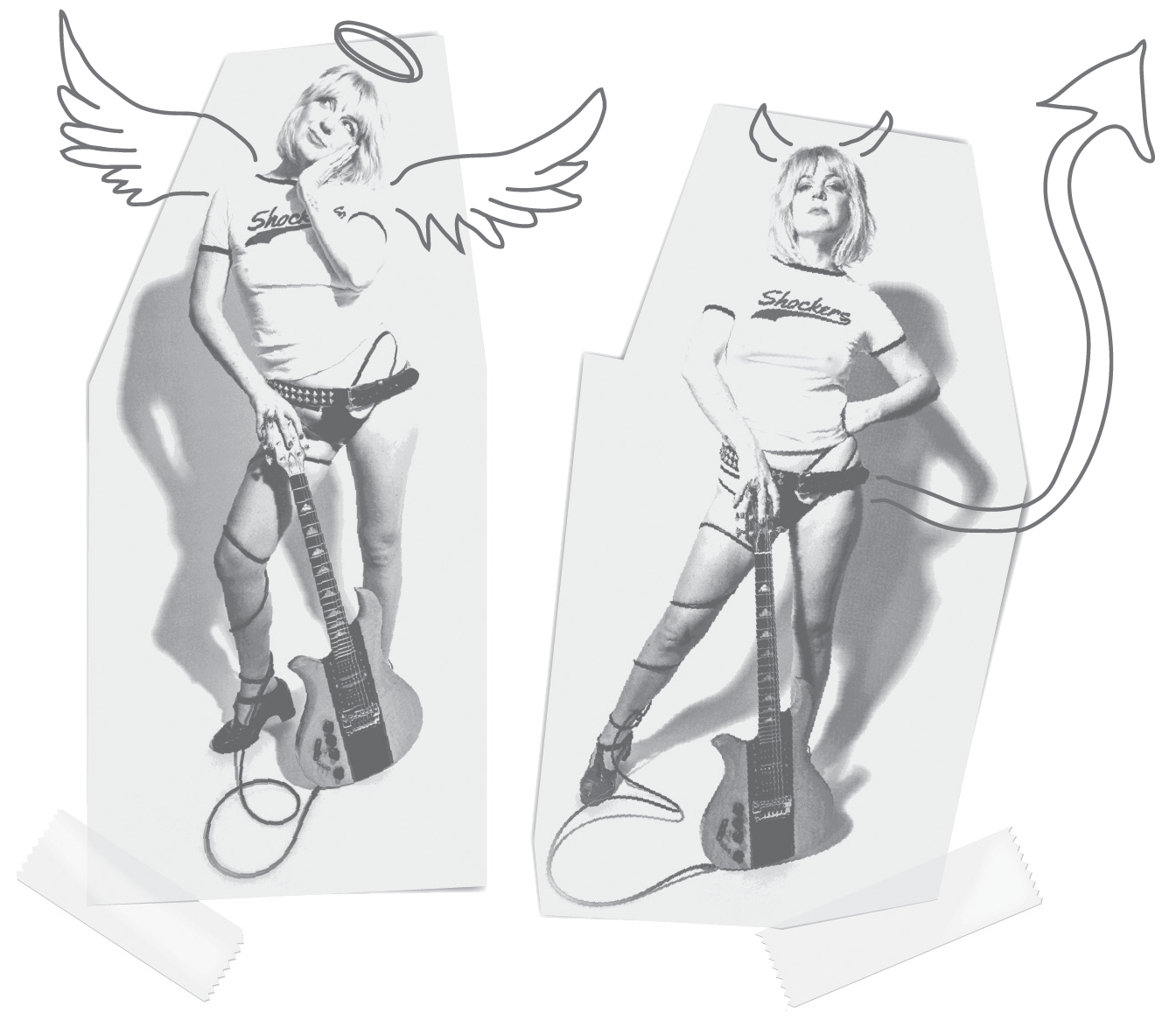
I won't share all the different touches, but I'll say that I extra enjoyed blinging up her author photos...


...and doing a little Glory Guitars treatment to Patti Smith's epigraph.


Glory Guitars
is available for preorder in all the main places, like Indiebound, and also on the University of Hell Press website where you have the added bonus that you can choose from five different variant color covers. It's officially out on October 11, which is also the International Day of the Girl. A cool promo video, is here. Here's an excerpt to let you know just what kind of punk grrrl you're dealing with:

By age fifteen, we had discovered an intricate infra-structure of debauchery across Fort Collins. Our entire network of punks and degenerates knew its secrets. We knew which liquor stores sold to minors: the cramped chunk of cement on Riverside Drive with a view of the train tracks; the more wholesome, suburban wine shop where parents might shop, yet they surprisingly didn’t ID. We knew which cafes would let underage people smoke inside: Max’s Subsonic—an old house turned café, with rooms to get lost in, that threw actual parties for underage kids—plus late nights at IHOP, and within the dingy, red-painted walls of Paris on the Poudre, the goth cafe. While I’m glad for the health of today’s youth, I almost feel bad they won’t ever experience the dirtbag tang of indoor smoking.

Teenage haunts are havens for illicit activity that are hidden in plain sight; they often have short names easily whispered in a pinch. The Ditch. The Dam. The Path. I knew the Path was a hard place the day one of the skaters shot a new girl at school with a duck gun as his friends erupted in laughter. I was horrified, but the fact that I didn’t do anything to help still haunts me.

There was the Starlite, the downtown punk club as shitty as its glittery aspirational name suggests. It hosted many of my friends’ bands, touring acts, and it even hosted an impromptu show in the parking lot featuring ALL, former members of the Descendents. Plus, the occasional party where girls wrestled in kiddie pools of Jell-O.

The memories of such parties and locations are often mysterious. I have a hazy memory of participating in Jell-O wrestling at the Starlite but can’t be sure. It happened during Corinne’s and my wrestling phase, a brief period when we couldn’t even be together without her getting an evil glint in her eye before thrashing me on whatever PBR-soaked carpet or viscid floor we were on. I have a glimpse of a memory of the Starlite, and looking down to see my white tee soaked in syrupy red. I have another piece of a memory of making out with a skater boy, Shane, in the back of a crashing car. Kitty was backing out and lodged the car into a pole.

~

*Not wanting to not give credit where it's due, the front cover photos were by the decidedly G-less Carri Lawrence.

Saturday, October 31, 2020

a moment in the day: mary

Just back from a run to the store that was presumably for general essentials but was more accurately for enough comfort food and drink to get us through the election, I cart bags down to the basement where we quarantine/store certain items routinely because: pandemic/apocalypse. Deposit my stock of bread, noodles, the many bags of Too Many Chips.

I pull wine out of the bottle bag. Each different bottle rings a different quiet note as it touches the concrete basement floor. I put them down, pick them up, rearrange. The Dark Horse rosé on the right, the Cocoban red on the left. The Immortal Zin moves from far left to directly in between them. Yes, that works.

Pick up the cava, put it down. It's not right. Move it away. Try the Dark Horse sauvignon blanc. It's not right either. Overhead the ceiling squeaks just slightly as Stephen moves through the kitchen, washing things down and putting them away. I reach, pick up the other red. Set it down in front of the rosé. Ah, perfect.

For a moment, I pick up the bottles and set them back down, pick them up, set them down. Quiet tink, tink of glass against the rough concrete.

I feel very proud of myself.

Taking the bottle bag back up the stairs to the kitchen, I tell Stephen I just taught myself to play "Mary Had a Little Lamb" on wine bottles. He's less impressed than I would expect.


Monday, February 3, 2020

two moments on airplanes


We're thirty thousand feet up. I'm kind of terrified of flying but I love all the parts that most people who fear flying fear: takeoff, touchdown, turbulence. Generally during the flight, I'm OK if I keep my mind on other things than the possibility of a fiery death: the movie playing on the little screen built into the back of the seat in front of me. The tiny bottle containing seven thimbles full of white wine. My nine dollar box of apple slices and cheese.

Down the right-hand aisle comes one of the flight attendants, who stops at the empty seat at the end of the row before mine. She leans in and asks the man at the other end, "Where's the man who was sitting here?"

"I don't know. He's been gone a really long time."

She picks up a small backpack from the seat. "He left his bag."

Well, there we go. It's a bomb.

I'll never see Atlanta and eat pimento cheese.

The flight attendant takes the bomb up and down the aisle, asking people if it's theirs. No, I'm sorry. No, I'm sorry. Well, of course it's not theirs. The man who left it has parachuted out of the back of the plane and we're all going down.

"Excuse me, is this yours?" There are two flight attendants now, checking with passengers. I wonder how much a bomb weighs. I wonder if time bombs actually tick.

The flight attendants come back up the aisle and finally stop just about where they began. "Excuse me, sir," to the man sitting in the seat in front of the empty one. He's an older man with white hair. I don't hear what he says, but he takes the bomb from the woman and apologizes. In a second I see his hand reach back into the seat pocket behind him, slowly pulling out the book he also left behind.

*

We're on the return trip from Atlanta. There are three in our row, Stephen, me, and the guy in the window seat who keeps getting up to use the bathroom. All three of us have our screens going and ear buds plugged into seat backs, watching movies. It's been a good trip, a whirlwind that included Stephen's two art events, visits to Martin Luther King's grave and the High Museum and the Madam C. J. Walker Museum and the Cyclorama and more and more and more. Fried green tomatoes. Pimento cheese.

Now, we're heading home.

I've been watching Fiddler On the Roof, and Tevye and Lazar Wolf are singing and dancing. It's a perfect distraction from the possibility of a fiery death to immerse yourself in musical joy.

As my eyes blink from one screen to another in front of me, I notice it's all music. A coincidence of timing that lets the song in my ears run through all three visuals. The guy to my right: a guitarist wailing away in a recording studio. Stephen to my left: Luciano Pavarotti belting an aria. It's a funny little montage. No matter what they're singing or playing, the music is mine. L'chaim, l'chaim, to life.

Saturday, January 4, 2020

Hedwig and the Angry Inch at Portland Center Stage


Man, I miss rock 'n roll.

I've realized in the last year or two that I hardly listen to music anymore. When I drive to and from work, I'm listening to the news. On my lunchtime walks, it's podcasts, and when I'm working on a design project and want something in my ears, it's old-time radio shows. In part, I think, because I don't have children, I've lost the thread of modern music. I don't know what it is anymore. But music used to be nearly everything to me.

And Hedwig and the Angry Inch, the film, was huge to me when it came out. What year was that? Wow, 2001. I was nuts for that film, especially the music, so I was equal parts excited and trepidatious when I heard Portland Center Stage's was going to be producing it. Would their Hedwig stand up to my revered image of John Cameron Mitchell? Would the music be tight enough? Would the show (feels silly for me to say, but) rock enough?

(Feels silly for me to say, but) The show totally rocks! And is hilarious and is raunchy and is complex and is a wonderfully immersive experience in the Armory's intimate Ellyn Bye Studio. And the set!

But wait.

Let me give you a recap if you don't know the story. You're in a mall. Yes, you. You're part of the show because you're a member of the audience as Hedwig, the genderqueer (I use that term specifically because that's how John Cameron Mitchell describes her) front-man for the broken-down rock band The Angry Inch, performs a show in the food court of an equally broken-down mall.

As she performs, she tells her story—being a boy in Germany; escaping from East Berlin to America with the aid of a botched sex-change operation (hence the "angry inch"); mentoring young rocker Tommy Speck; losing her way as Tommy Speck became superstar Tommy Gnosis, stealing her music as he left her behind.

Delphon "DJ" Curtis Jr. as Hedwig

But now, relating her story on stage, accompanied by her four-piece band and her backup singer/husband Yitzhak, Hedwig is head-up and haughty, audacious and sexy as she rocks the house in that sad, dilapidated mall—oh, but I was telling you about the set!

It's perfectly awful. And I mean perfectly in the positive sense. The overflowing trashcan, the broken candy machine, the half-burnt-out neon sign over the entrance to the mall-embedded Chili's restaurant. I love the signs that advertise the place as the "Star Court," a branding that's also on that broken vending machine. But the pièce de résistance is the tongue-in-cheek irony of the poor, dead escalator, standing in for the luxurious staircases of the musicals of Golden-Age Hollywood.


Hedwig is played by actor Delphon "DJ" Curtis Jr. His vocals seemed a little unsure at the start of the show, perhaps opening night jitters, but it didn't take long for him to find his footing. As an actor, he mixes Hedwig's haughtiness with just the right amount of bitterness and poignancy, and his sexy banter with the audience brings lots of laughs. I enjoyed the moments when he was playing both Hedwig and Tommy, switching back and forth between voices, accents, genders. When he more fully takes on Tommy's character toward the end of the show, it's a fabulous transformation.

As a singer, Curtis has a lovely voice. What an incredible range. It can take him from quite low to beautifully high, as in the surprising opening to his performance of "Hedwig's Lament." And when he's in full-on rock 'n roller mode, he hits some high notes that blow you away.

Delphon "DJ" Curtis Jr. as Hedwig and Ithica Tell as Yitzhak

If you're familiar with the film, take a tip and see the play. It's beautifully constructed around the device of the shopping mall performance, with the story of Hedwig's life perfectly weaving in and out. You're immersed in not only the drama of the stage play but the joy inherent in a rock show. There's a wonderful moment from an editing standpoint where Hedwig is telling you just how it came to pass that she was persuaded to have the botched sex-change operation. Suddenly the music starts and she sings, "When I woke up on the doctor's slab." From the moment before to the moment after—and you go from this very dark place right into music. Powerful, driving music. That's when I thought to myself, "Man, I miss rock 'n roll."

You could have a blast at Hedwig and the Angry Inch for the music alone, but it's also a surprisingly moving show. Stephen said the same thing to me, leaving the theater: "I was surprised, I got a little teary." (OK, me, I got very teary.) Stephen talked about Hedwig's emotional transformation, and I'm going to leave it at that because there's a surprise twist not only for those of you who, like me, were enamored of the movie but unfamiliar with the stage play, but also for those of you who've seen the play before, and I hate spoilers. But what was interesting to me was that while Stephen's emotional reaction came for Hedwig, mine was for Yitzhak.

Both characters have their moments of emotional climax (man, after all the double-entendres in that show, my brain has a little slant to it today). The thing about Yitzhak is that he's so in the background for much of the show that the conclusion of his particular story arc, at least for me, hits surprisingly strongly. I'll leave it at that because again with the spoilers, but let me talk for a moment about Ithica Tell.

Ithica Tell as Yitzhak

I loved her in a recent production of The Color Purple, and I was intrigued to see her name in the cast list as Yitzak. I thought she was a wonderful choice. She does great deadpan straight-man work as Hedwig's long-suffering husband, and her quiet smolder of in-the-background bitterness provides a great build-up of tension as we follow her own story as it rides secondary to Hedwig's.

Like Delphon "DJ" Curtis Jr., Ithica Tell also has quite a range on her, vocally. She's able to go from very feminine to very masculine as she sings backup on Hedwig's songs. This range combined with her beautifully masculine look gives Ithaca Tell's Yitzhak the perfect gender mix for the show, I think, and makes her seem just right as Hedwig's other half. 

I thought she did a sweet turn on her solo "The Long Grift." Her voice on that was clear and lovely feminine. Then elsewhere her sound would be surprisingly masculine, like on the backup vocals of a certain song where she was so deep and angsty she reminded me of the heavy metal music of my youth. It was very different from what I remembered of the same song in the film, and it felt so much more effective, so much more powerful. I loved the interpretation. So much that I wanted to tell you all about it, but one day later, and I can't remember which song! I've been wracking my brains. That's what a lot of my experience of theater tends to be like, actually, with this incredibly flabby memory of mine. The next day I'm basking in the reminiscence of a lovely evening, but the particulars have faded and what I'm left with is the memory of feeling. Of all the laughter, of the joy of music, of the surprise of tears from a moment unexpected. Portland Center Stage's Hedwig and the Angry Inch is a very full show and even as we were leaving the theater, I was craving another look. "Makes me want to watch the movie," I told Stephen.

Stephen countered with, "Makes me want to see the play a second time." 

We may just do that.

*

Hedwig and the Angry Inch is playing now through February 23rd at the Armory. More information is here.

Photos by Owen Carey/Courtesy of Portland Center Stage at The Armory

Poster art by Mikey Mann

Wednesday, September 11, 2019

In The Heights at Portland Center Stage


In the Heights, the award-winning musical by Lin-Manuel Miranda and Quiara Alegría Hudes, is three days in the life of a mostly Hispanic-American neighborhood in Washington Heights, New York. Usnavi de la Vega, whose first name comes from the first sight his parents spied when they arrived in America from the Dominican Republic (a ship with a sign reading US Navy), owns a bodega in the center of the barrio but dreams of getting out and returning to the land his people came from. Also living and working here are Kevin Rosario, the ambitious owner of a taxicab business; Benny, his dispatcher and the one non-Spanish-speaker around; and Abuela Claudia, the loving matriarch of the barrio. Kevin's daughter Nina, the one often praised for being the first to "make it out," has just returned from Stanford University, not quite ready to tell her parents and friends that she has dropped out.

There's also Vanessa, the salon worker who dreams of having her own apartment outside the barrio but can't afford the down-payment, and the Piragua Guy, who sells Puerto Rican shaved ice in fierce competition with Mister Softee. There are relationship problems and thwarted ambitions and a huge citywide blackout during an intense heat wave, not to mention the winning lottery ticket that has just been sold at Usnavi's store, but through it all, the central theme in In the Heights is home.


What does home mean? Is it something to endure, something to go out and find, something you're given, something you create?

The answer, of course, is yes, but it's much more interesting an answer when it comes with the music and drama and wit of Lin-Manuel Miranda and Quiara Alegría Hudes. We saw Saturday night's performance of the production put on by Portland Center Stage, one of my favorite Portland theaters. I've never seen Hamilton and didn't know what to expect with In the Heights. I'll admit that at first I was afraid it would be difficult to follow for the likes of me. As the music began, the rhymes and the wordplay were coming at me so fast, but by halfway through that first piece, my brain had caught up and I was along for the ride. Here's a little taste:

I am Usnavi, and you prob’ly never heard my name
Reports of my fame are greatly exaggerated
Exacerbated by the fact that my syntax
Is highly complicated 'cause I immigrated
From the single greatest little place in the Caribbean:
Dominican Republic!
I love it!
Jesus, I’m jealous of it
And beyond that
Ever since my folks passed on
I haven’t gone back
Goddamn, I gotta get on that...


I can be kind of a jerk when it comes to modern musicals. Well, at least inside my head. There's a sameness and a preciousness and... just a sound I don't always enjoy. But In the Heights is different. The music is a mix of salsa and rap, feeling like the best of America: the vibrancy of its diversity and the energy of its perseverance. And it's so darn fun. The orchestra for Portland Center Stage's production, led by Eugenio A. Vargas, is tight, and the singing is first rate. And there's plenty of dancing by the whole, large cast. Including breakdancing! So much energy, so nonstop. We had to wonder how pooped the cast was when they finished the show.


See in the above picture? That balcony above the bodega? Not only does some of the action of the performance take place up there, but the whole band—keyboards, reeds, guitar, trumpet, bass, drums—is mounted up there. Like the music is a part of the barrio, which feels perfect.

Some of my favorite parts in the show were delivered by secondary characters. Lillian Castillo was fantastic as Daniela, the feisty salon owner and neighborhood gossip, and I loved whenever she was suddenly, surprisingly belting it out on stage.

Center: Lillian Castillo as Daniela

Another high point for me was "Enough," the song sung by Camila, the mother of Nina and the wife of Kevin, as she gives them both a piece of her mind about all their fighting and pig-headedness that's been driving the family apart. Carmine Alers performs the song with equal parts fierceness, funniness, and grace. It's a wonderful surprising turn for the character, and it's delivered beautifully. After the show, I looked up and watched some clips of that song to enjoy it again, and I found actors who tried to push too much tragedy or too much rage into their performances. Alers' delivery felt exactly as the song should be.

Left: Carmine Alers as Nina

The night we saw the show, one of the actors must have been sick, because there was a cascading of understudies in a handful of characters, and one of the very biggest parts in the production, Nina, the romantic lead, was played by someone who doesn't normally play the part. She was great! Energetic and confident and nuanced and seemed like she must have been performing that character from the start. I don't know how much practice time understudies get, but Paola Hernández, who pinch-hit as Nina, and Emily Madigan, who pinch-hit as Carla, were both terrific. As was Debra Cardona, who's doing a short run as Abuela Claudia. 

It says something about the actors, of course, but it also says something about the production as a whole, and how well it works together. Portland Center Stage's In the Heights works together very well. It's one of those shows where, in the end, you think that maybe the most important "cast member" is the ensemble. It sure feels that way when the stage is alive with music and dance. Like the rollicking "Carnaval del Barrio," the song that celebrates finding joy in both good times and bad, In the Heights, through all the plot's ups and downs, is simply a really good time.


It's playing now through October 13. More information is here.

Photos by Owen Carey/Courtesy of Portland Center Stage at The Armory.

Poster art by Mikey Mann.

Sunday, September 23, 2018

The Color Purple at Portland Center Stage


I had seen the movie and read the book. My date had done neither. I kind of envied how fresh the story was going to be for my friend, but it's always fun to see how something you know is reborn in a new form. In this instance, it was The Color Purple. I was very curious what a musical based on Alice Walker's classic novel would be like, and what Portland Center Stage would do with the material.

I have to admit that I am not overly a fan of the music in modern musicals. It's my own problem. There's something about the general style that tends to put me off. So I was a weensie bit nervous as I went down to the Gerding Theater to see the show. But PCS's production began with music that started sweet and then blossomed into a full-fledged old-time gospel tune that filled the theater and put a huge grin on my face.

The score for The Color Purple is a mix of modern and period pieces. The more contemplative or solo pieces tend to be more modern, with the bigger production numbers more period. Contemporary music written in the style of old time music can often be a sad, limp imitation, but I think this score pulls the period stuff off beautifully. Some of my favorite songs featured a Greek Chorus trio played by Lauren Du Pree, Nia Marché, and Ithica Tell as church ladies in a manner reminiscent of the "Pick-a-Little, Talk-a-Little" ladies from The Music Man. 

It's worth noting today, as the first official day of Banned Books Week, that Alice Walker's novel has frequently been challenged and censored for reasons ranging from sexual and social explicitness, to violence, to "troubling ideas about... man's relationship to God." I thought the role of "man's [and woman's] relationship to God" was framed beautifully by the songs written for the musical retelling of the story. It doesn't matter whether you're a spiritual person or not. It's a thread that goes beyond the question of belief or religion. Celie's relationship to God has its own arc, which compliments the arc of her character as she (here come the spoilers) endures abuse, as she gives up her babies, as she's married off to "Mister," as she pines for her sister, as she falls in love with Shug, as she slowly finds self worth and independence.


Celie is beautifully played by award-winning Broadway actress Felicia Boswell. Boswell has big acting and singing chops and, like the character of Celie, seems to grow on stage. Toward the end of the production I found myself actively wondering how old the actress is, noticing that even from my fabulously close (4th row) seat, she appeared to have gone from girl to woman, slowly, seamlessly, in front of my eyes.

Another stand-out is Chaz Lamar Shepherd, who plays Mister. His performance of "Mister's Song/Celie's Curse" knocked my socks off.


The main stand-out for me, musically (and I'm cheating a little by saying this), was the ensemble, though. The mix of voices was somehow absolutely perfect in my ears, a gorgeous thing.

But I have to say, for me the star of the show (and when I mentioned this to my friend afterwards, he said it was the same for him) was the set. Or set and lighting, together. I debated mentioning this without explaining it, but in Portland Center Stage's own Flickr stream of promotional photographs, it's right there to see, so I figure it must not be too much of a spoiler.

But if you're a stickler about spoilers...

...like me...

...and you don't want to know until you've seen the show, stop right here and, well, see the show.

But if you want to read on...

...and see a couple of those pictures (which will give it away instantly, which is why I'm playing this little broken-paragraph game with you right now)...

...then read on.

The set is minimalist and bordered by walls of wooden slats. The wood looks worn and gives a nice sense of time and place, but somewhere along the line - surprise - the slats open up. It's a deceptively simple bit of stage magic used cleverly and skillfully in conjunction with light and color throughout the production. When the slats are shut, and depending on how the lighting is used, there's a sense of intimacy, or of claustrophobia. When they're open, they let in the world, they create dreams, they remind you of prison bars, they give you the sky.


Color, light, shadow, and set are all used with precision and with beautiful variation. I'd go see the show again just to track the visuals so expertly designed and executed by scenic designer Tony Cisek and lighting designer Peter Maradudin.

And there's one more surprise that happens with the set at the end that's pretty fantastic. My friend, watching beside me, later told me that as this last surprise was starting to happen, he turned and watched my face, looking for the moment when it would dawn on me, too. I want to talk about what it was and what it means, but no. I'm going to dispense with the spoilers and keep that one to myself.

The Color Purple is a wonderful production of the classic about womanhood, sisterhood, and redemption. It's playing at Portland Center Stage through October 28th. More information is here.

Photos by Patrick Weishampel/blankeye.tv courtesy of Portland Center Stage at The Armory.

The poster art is by Mikey Mann.

Captions are wreaking havoc with Blogger's spacing, so I'm going to include them below:

Photo one: (L-R): Felicia Boswell as Celie and Danea C. Osseni as Nettie

Photo two: (L-R): Felicia Boswell as Celie, Danea C. Osseni as Nettie, and Chaz Lamar Shepherd as Mister

Photo three: Chaz Lamar Shepherd with members of the cast

Photo four: (L-R) Felicia Boswell as Celie and Danea C. Osseni as Nettie with members of the cast

Sunday, May 13, 2018

a moment in the day: on the staircase


We stand on the steps in the dark. It's André and I, side by side, at the top—well, halfway up the staircase, but we're for the moment the highest eyes in the place, and we can look down over the shadowy spill of courtiers down the staircase and spreading out across the stage—courtiers, concubines, Duke and jester. We're in a long, narrow pocket of stage, the dark curtain in front of us, the elaborate set and backdrop behind, and out beyond the curtain is an orchestra pit full of musicians and a house full of an audience. Here just halfway up the steps, I'm on the top of the world. Except for all the people in the two balconies out there in the theater, but who's counting?

It's closing night for Rigoletto. I don't want to see it go, I don't want to see it go.

There's a murmur of hushed conversation across the stage. Studs of light start up in the dark as players with candelabra switch on their electric flames. The chorister in front of André touches one of his candles to one of the candles of the chorister on the next step down. Uani, the super on the step below me, has a wine goblet in one hand and one of those masks on a stick that you can hold up to your eyes, in the other. My party prop is just a wine goblet. I kind of covet the masks and the candelabra, but there's no way I'd make it up these stairs without stepping all over my mass of skirts, if I had to do it holding onto more than this goblet.

Beyond the curtain comes a single note, held long. Then another, an octave higher, another an octave lower. The orchestra is tuning up. André hums along. His voice is beautiful even when he's playing around, humming a note mid-range, then a note up high, then hitting a tone way at the bottom of his register. Under my breath, I join in, quiet, wanting to be part of the music.

When the conductor makes his entrance, the applause seems to start behind me, a crackle across the faux stone walls and balcony of the set.

I have a frog in my throat. I keep trying to clear it, quietly, and somehow this feels disingenuous, like, what, it's not like you're going to go out there and sing.

There's a silence and then the overture begins. I take my eyes up into the blackness of the fly space way high over my head. Listen to the music. A cluster of light that looks like a surreal flower moves across the curtain, descending. I always wonder what it looks like from the front side. André's still humming along with the music. Under this, a quiet rattle as the outer curtain rises. Only the outer curtain—for one more moment, the whole raucous party in the Duke's court is still hidden in the dark.

The overture hits its crescendo. The curtain comes up. The light comes up. And we're all laughing.

Sunday, January 28, 2018

Astoria: Part Two at Portland Center Stage


I had a chance to see Astoria: Part Two at the Gerding Theater at the Armory. I debated because I hadn't had a chance to see Part One, and I worried that it'd be difficult to follow, coming in at the middle and with such a large cast to track, and I'm not exactly the sharpest tack in the deck.

Alright, my husband's going to give me a hard time for saying that, so I'll clarify. I tend to get a little lost when a lot of details are coming at me fast, and the biggest thing: I have a really hard time recognizing faces. Often when we're watching movies at home, Stephen will lean in and quietly murmur during a pause in the action, "Remember that guy's the ex-husband of the older sister."

He wasn't with me Friday night when I saw the play, and of course I wasn't going to lean in to my date and periodically whisper in that packed theater (incidentally full of people who probably knew every character from last time): "Wait, who's that guy?"

So when the lights went down and the large cast of mostly men started to range across the stage, I thought, oh no.


And it was true—there were times when I thought, wait, who's that guy, but in the end, it didn't matter.

I'm here to tell you that even if you haven't seen Part One, even if you're as faceblind as I am, you can thoroughly enjoy PCS' beautifully produced, thought-provoking, action-packed, fully-contained epic Astoria: Part Two.

My early panic over face recognition quickly gave way to the realization that I didn't need to track every character because this was a much bigger story. There are individual plotlines that are fascinating to follow, of course, but for me, this is a story about big picture. About groups of people and the things that drive them apart and the things that bring them together. The instinct for survival being one of them.

The Astoria story follows the adventures of the Astor Expedition of men—and one woman—to establish trade routes to the Pacific Northwest, ultimately leading to the founding of Astoria, the first permanent United States settlement on the West Coast. The plays are adapted by Chris Coleman, based on Peter Stark's very popular book Astoria: John Jacob Astor and Thomas Jefferson's Lost Pacific Empire, A Story of Wealth, Ambition, and Survival. Portland Center Stage's productions are their world premier.

It's a harrowing tale. Driving home afterward I was mesmerized by the streaks of streetlight red and green and the streetlamp yellow along the rain-wet asphalt streets. Me in my car with the classical station on and the heater going. My god, the lives these people lived, trekking across the wilderness of early-1800s Oregon, fighting to survive, unwittingly helping to lay the groundwork for the easy life I live today.


Like many old Hollywood epics, this play included a cast of thousands. OK, I guess that's not true, but I didn't look at a program before or during the production and was surprised to find out, when I got home and started looking at PCS's website, just how many different characters had been portrayed by their robust 17 person cast. It really did feel as though there were something like 75 different cast members filling out the show.


Standouts for me included the fabulous Leif Norby and the very versatile DeLanna Studi who play not only various characters along the arduous trail—including Marie Dorion, the one woman on the 1811-12 overland expedition— but also John Jacob Aster and his wife Sarah Aster in their much more comfortable New York City home setting, creating a fantastic contrast to the brutal wilds of the American Pacific Northwest.


But it really was the ensemble that was the true standout for me. The way the cast told the story, breaking sentences up, back and forth, between them like some leapfrogging Greek Chorus underlined the fact that this was a tale of people, not persons. And my favorite thing? The music. I hadn't expected to find that Astoria is a musical of sorts, with that large cast breaking out in beautiful harmonies, in songs that felt completely authentic to the time. The music again reminded me that this story was a far larger tale than just the individual threads of the particular characters, but it also seemed to make the statement that no matter how difficult and, at times, cruel the world—and the world of men—can be, there is beauty in that world and in what man can make of it.

Astoria: Part Two is playing now through February 18th on the Main Stage at the Armory. More information—including a video you can watch to refresh your memory of Part One (which I did not watch, actually, before I saw Part Two [for more information on why I failed to do this, see the last line of paragraph one of this post])—is here.

Thank you to Patrick Weishampel/blankeye.tv for the photos.

Sunday, February 12, 2017

His Eye is on the Sparrow at Portland Center Stage


I was glad I knew nothing about Ethel Waters before going to see His Eye is on the Sparrow in the
Ellen Bye Theater at Portland Center Stage Friday night. Oh, I knew she was a singer who had popularized wonderful old songs like "Stormy Weather" and "Am I Blue." I knew she played Berenice in The Member of the Wedding. But I knew nothing about her life.

It was wonderful to sit in that intimate theater and watch her story unfold through narration and song. His Eye is on the Sparrow, written by Larry Parr, is essentially a one-woman show (I say essentially because she's accompanied by a piano player), in which Ms.Waters, played by Maiesha McQueen, guides us through her troubled childhood, her sad young life as a grudging teen bride, her surprise rise to stardom accompanied by feelings of inadequacy in the face of the racism and sexism all around her, her seclusion as an older woman followed by her return as a gospel singer - and most of all, her songs.

Fabulous songs. "Heatwave." "Old Man Harlem." "Franky and Johnny." "Black and Blue." Songs beautifully performed by Maiesha McQueen in a voice that ranges from sweet to deep to playful to mournful, and a performance that, above all, rings authentic. One of the biggest pitfalls of a show like this one is inauthenticity, and McQueen's performance is not a modern take and not a pastiche. It's the real deal.


I loved the whole of McQueen's performance. She's funny and heartbreaking and brassy and dynamic and again, again, so authentic. Authentic to the time period(s) and authentic to the human experience.

I have to admit I don't tend to be interested in stars or the lives of stars. Packed houses on concert tours and actors' searches for that perfect movie role aren't stories that move me. But His Eye is on the Sparrow is not a play about stardom. It's a story about human relationships, the struggle to make connection. It's a story about race, and the ways people internalize the unfair inequality around them. It's a story about womanhood.

And OK, yes, I lied: it's a story about stardom. But what that particular thread in the production said to me had little to do with stardom, per se.  Stories about stars are often about persistence. How they struggle to realize their full potential, how they persevere to reach that place in the spotlight. The Ethel Waters I saw last night at Portland Center Stage seemed to have the spotlight handed to her in a gift-wrapped box, and the persistence that marked her life centered around other things. Real things. Most of all, simply the struggle to feel equal in the world.


As I left the theater, a phrase kept playing in my head. She was a star, and she just wanted to be on par.

Silly rhyme notwithstanding, this was the takeaway that stuck with me the most. She had achieved so much - stints on Broadway and the concert stage, appearances in the movies and on TV, record contracts; she was the second African American woman nominated for an Academy Award (Pinky) and the first African American  woman to have a lead role in a television series (Beulah) - and she still felt less than. Less than her fellow man. Less than her fellow White man.

When she persisted, she was called difficult. And perhaps she was. But these were difficult times for Black women. Still are. I can't help it: my mind goes to the recent Senate Judiciary hearings on Jeff Sessions and two women's voices (Elizabeth Warren's and Coretta Scott King's) silenced in their attempt to speak truth about racism. Nevertheless, she persisted. This is what Ethel Waters does throughout her story. She persists. Not toward the kind of achievement that wants to be measured in Academy Awards and television ratings and Twitter followers, but toward authenticity.

Somewhere in the second half, I was compelled to fish a pen out of my purse and scribble on the back of my program a line Waters says. She's describing White people and the line is both biting and sympathetic. "Their souls have been pushed down somehow."

This felt so true and so ironic. With all the efforts, conscious and unconscious, that White America has made to put themselves - ourselves - above, our souls have been pushed down.

But what happens during the play: you feel lifted up. By Ethel Waters' music, her truth, her hilarious barbs, her persistence. And it isn't just her. I said before, His Eye is on the Sparrow is essentially a one-woman show. Maiesha McQueen's partner on stage is Darius Smith. Beyond being musical director of the production, he plays the piano for her performance beautifully, but his presence is more than that. From the way he escorts her through the theater in the opening of each act, to his quiet attentiveness to her performance, Smith seems to be some sort of opposite Greek chorus. Rather than commenting on the action, telling the story for her, he listens. He sits back and actively lets her tell her truth. He attends with grace and respect, and with this, he seems to represent that something that Ethel Waters always deserved.


His Eye is on the Sparrow runs through March 19th. More info is here.

Thank you to Patrick Weishampel for the photos. Theater poster designed by Julia McNamara. The picture of Ethel Waters from Wikipedia Commons.

Wednesday, December 7, 2016

Hershey Felder as Irving Berlin at Portland Center Stage


Stephen and I are huge fans of Irving Berlin. So much so that on Friday night, after we watched the sweeping biopic one-man-show Hershey Felder as Irving Berlin at Portland Center Stage, happy in that afterglow of a good night of theater, we had to go home and watch Carefree, one of the Fred Astaire and Ginger Rogers films featuring Irving Berlin's music. I'd been up since five and had worked all day and I knew I'd fall asleep within probably the first half hour, but I didn't care. I had to have more.

And I did. Both. I had more and I fell asleep. Contrary to what the movie poster advises, I did not stay awake to see them do "The Yam." But it didn't matter because earlier in the evening I'd been treated to Irving Berlin's entire life as encapsulated and dramatized and sung and played on piano by Hershey Felder, the playwright/performer who has brought to life such figures as George Gershwin, Chopin, Beethoven, Abraham Lincoln, and Shirley Temple. OK, he never did Shirley Temple, but I wouldn't be surprised if he could pull her off. He did some pretty nifty impersonations during Irving Berlin, including a pretty spot-on Ethel Merman, and I figure from there it's just a short hop, skip and a jump to the Good Ship Lollipop.

The show opens with Felder as a young Irving Berlin in conversation with his older self as personified by a wheelchair that sits stage left throughout the performance - and then he proceeds to take us through his whole life, starting with his childhood. It's a lot to encapsulate: one hundred and one years, in fact! It's a fascinating life, from the triumphs of his career to the heartbreaks of his lost loves, and through it all is music. To name a few of the songs Irving Berlin wrote: Cheek to Cheek, Alexander's Ragtime Band, I'm Putting All My Eggs in One Basket, There's No Business like Show Business, Anything You Can Do I Can Do Better, Easter Parade, Always, I Used to be Colorblind, God Bless America, The [aforementioned] Yam, Blue Skies, What'll I Do, I'll See You in C-U-B-A [popularized by the character of Ricky Ricardo], Puttin' on the Ritz, I've Got My Love to Keep Me Warm, and White Christmas.

Felder doesn't just tell the story of Irving Berlin's life. He sings it and plays it - sometimes accompanying his own singing, sometimes accompanying clips of famous film flashed on the huge decorative mirror center stage - and, heads up: at one point, he makes you sing it too. I usually hate singalongs. After the show, my husband said to me, sort of incredulous, "You sang along!" I don't know what made me go for it this time. Maybe it was Hershey Felder's very personal performance that made me feel comfortable. Maybe it was that I felt proud that I knew all the words and didn't need his calling them out to help jog my memory. (Even if my knowledge of some of the songs was a little less classic Irving Berlin. Here's my favorite rendition of one, Always, performed by the powerhouse Damita Jo with Steve Gibson's Red Caps.)

In his performance as Irving Berlin, Hershey Felder has lovely timing. He takes us to very deep places, bringing us just to the brink of melodrama in a manner that is befitting a figure who pens such lines as Soon we'll be without the moon / humming a different tune and then / There may be teardrops to shed / So while there's moonlight and music and love and romance / Let's face the music and dance. And from that brink, he does a quick about-face and drops into a joke, or simply directs his energy forward as if Berlin is saying to us with that dry wit of his, eh, life moves on.


These days I can't see a show, watch a movie, read a book without pulling in some extra layer of context based on the current political climate and the changes that have come and are going to continue to come into our world. During a lot of Hershey Felder as Irving Berlin, I found myself musing on, and occasionally suddenly choked up about, the idea of Berlin's patriotism, his devotion to this country. Here was a man who was born in Russia, lived in poverty, immigrated to America with his family in search of a better life. Here was a Jew who, ironically, gave us Easter Parade and White Christmas, who had changed his name from Israel Isadore Baline in response to anti-Semitism. Here was a man who, with all of his fame, was still "other" within the culture, still felt (at least from what I learned from Felder's performance) like an outsider, yet held onto a deep love of this country and gave us one of the most patriotic songs of the American canon, God Bless America. Called America his "home sweet home."

As this country moves more and more toward marginalizing and rejecting its immigrants and its so-called "outsiders," Hershey Felder's Irving Berlin has what we need: a determined love of home, a soupçon of old fashioned schmaltz (no, I mean that in a good way), and a reminder that, no matter what happens, there will still be music.

It's running through December 30th at the Armory. More info is at Portland Center Stage here.

Thank you to Eighty Eight Entertainment for the pictures and Wikipedia Commons for the Carefree poster.

Sunday, October 23, 2016

City of Weird Contributor: Kevin Meyer


Kevin Meyer's was the last submission to come through Forest Avenue Press' Submittable page for the City of Weird anthology at something like a minute before midnight. Maybe he thought that would be a fitting time to submit for a collection of fantasy and horror tales, or perhaps he's like me and always wants the freedom to keep tinkering up until the last moment. I knew as soon as I checked it out that I was going to take the story. It was everything I was looking for. It took a trope from the genre of "weird fiction" and turned it on its ear, making a story about one thing into a story about something else. It was equal parts creepy and hilarious. It was super fun and it was suuuuper weird. And as a bonus, he'd taken an existing piece of Portland lore and essentially written a sequel. Which is like using a Portland landmark but even better.

That urban legend is Polybius, a video game that was supposed to have surfaced in 1981, wreaked havoc on game players, and then disappeared without a trace a month later.

Those who say Polybius was only an urban legend need only look here for proof of its existence.

Kevin Meyer has been a co-facilitator for the Dangerous Writing fiction workshop and his work has been featured or is forthcoming in The Frozen Moment: Contemporary Writers on the Choices that Change Our Lives, Share PDX, Nailed Magazine, Noisehole Magazine, Gobshite Quarterly, and The Untold Gaze.

He's also an accomplished musician who performs under the name of Astro Warrior. I've watched him work, and it's fascinating and mesmerizing. I think what he does is called "noise music," and it's done by plugging cords and flipping switches and turning dials on synths that look like they come right out of the 1950s-era futuristic stories that partly inspired City of Weird. But it's not all space-age smoke and mirrors - it's skillfully created, kick-ass music. I shouldn't be allowed to use phrases like that, but there it is. You should totally keep an ear out for Astro Warrior gigs.


You can check his music out here.

Here's an upcoming show: November 3rd at Atlantis Lounge in Portland. More info is here!

It's also his birthday today.

The story "Out of Order" has one of my favorite last lines in City of Weird. But I'm going to give you a taste from the opening section. To hear more, come on down to Broadway Books this coming Tuesday (October 25) for our second City of Weird reading. There will be Voodoo doughnuts and we're hoping folks come in costume. The facebook event is here.

But now, in lieu of asking the entire internet to sing him Happy Birthday, here is a little taste of Kevin's writing.

I keep going back to that arcade-bar in Old Town, Ground Kontrol, to play Polybius. I’d never heard of Polybius until I saw the worn, eighties retro cabinet in the back corner of the lower floor of Ground Kontrol, lit up in the dark. 


Polybius isn’t even that fun, but it doesn’t matter. I can’t stop myself. I keep going back to play, even though I’m pretty sure Polybius is what started this whole thing. 

The thing is, I can’t remember. 

Every time I black out, I wake up and the dog’s licking my nosebleed. She’s a little dog, a Sheltie, couldn’t weigh more than twenty pounds, but she feels like a ten-ton hangover on my chest. Her sloppy, wet tongue and dog-breath stink on my face. 

I’m dead certain I’m going to wake up the way that French woman did a few years back. The one who got the world’s first face transplant after she passed out on painkillers and woke up with half her face missing. It wasn’t like her face vanished while she was passed out. Her goddamned dog chewed her face off.

Sunday, September 18, 2016

little shop of horrors at portland center stage


Little Shop of Horrors was beloved in my household when I was growing up. At the drop of a hat, we would put on the soundtrack and sing our hearts out at the dinner table, and now, years later, with all of them far away in California, the thought of that shared joy over music and blood-thirsty man-eating potted plants makes me want to cry. Watching it again, Friday night at Portland Center Stage, I think I smiled the entire time.


It wasn't just nostalgia, although the moment the song "Skid Row (Downtown)" began, I had that thing happen where all the skin on my legs tingles. I think that's my body's equivalent of getting the chills. And I know those chills in that moment, and the grin that spontaneously clamped itself to my face, were pure nostalgia. But the way that smile wouldn't let go through the whole show, and all the laughter that probably annoyed the woman seated to the left of me, that was pure Portland Center Stage.

I was worried, as I always am when I'm watching a performance of something I've known in movie form, whether this production would be able to stand up to that old, beloved version. And would they go for a classic rendering or throw in a twist (which sometimes works, sometimes doesn't)? Portland Center Stage's production of Little Shop of Horrors is totally classic*, and totally works. It's got the beautifully pipsqeaky Seymour, the bombshell-squeaky Audrey, the giant puppet plant, all of it. But I wasn't jonesing for a Rick Moranis or a Steve Martin. I guess the closest I came to missing something was, early on, being aware of just a hint of longing for Ellen Greene's (the original off-Broadway Audrey who reprised her role in the 1986 film) surprising voice switch from squeaky to something husky and odd and powerful at certain spots in her songs. I knew I couldn't expect it. That was not classic Little Shop, it was classic Ellen Greene, and to have another actress mimic that would not be right. Still, I had a little craving. But it didn't last long. Gina Milo's voice is beautiful and pure, and her high notes are powerful in their own right.

Gina Milo


She also works the line between humor and sweetness very well. When she came to the end of "Somewhere That's Green," this moment of poignancy that has to struggle to exist in all of Little Shop's luscious camp, I thought to myself, wow, I totally believe her.


Nick Cearley, too, was funny and nuanced. He played Seymour as Seymour should be played, but with lovely timing that kept the most easily caricaturable part in the show from being a poor parody.

Jamison Stern and Nick Cearley


Jamison Stern was particular and beautifully slimy as Orin, Audrey's sadist-dentist boyfriend. The scene in the dentist's office, Orin in his nitrous oxide mask, that terrific prop and the way the sound quality of his voice was used - egad, it made me the perfect kind of uncomfortable.

I so loved Johari Nandi Mackey, Alexis Tidwell, and Ebony Blake as Chiffon, Crystal, and Ronette. Their beautifully melded voices and knowing commentary, sometimes playing Greek chorus behind the action, sometimes egging that action on, was a fabulous thread throughout the show. And for me, seeing this now after a long time, seeing it as an adult in this particular time and place, there was an extra layer to the musical that Chiffon, Crystal, and Ronette provided the grounding for.

Jamison Stern, Alexis Tidwell, Johari Nandi Mackey, and Ebony Blake


Having a drink at the Gerding before the show, my date for the night, Liz, discussing a recent documentary she'd seen, remarked, "I'm always aware of my privilege as a white woman, but what I hadn't been as conscious of was how hard it would be for me to give that privilege up." It was something I'd been thinking a lot about, myself, recently, and the statement stayed with me as I watched the show: Chiffon, Crystal, and Ronette sitting on a rundown Skid Row staircase, Chiffon, Crystal, and Ronette always on the streets, watching as more and more privilege was heaped on white Seymour and white Audrey and white Mushnik. As the action ramped up and the rift between the haves and the have-nots got wider and more dangerous, I realized what I hadn't as a teenager who'd been in love with the music and the fiendish humor in the play: this thing, underneath it all, is about some pretty serious stuff. And our hero, for all his clumsy sweetness, who, yes, only goes along with this man-eating-plant stuff when the victim feels, you know, kind of deserving, nevertheless lets privilege keep him from attempting or even considering destroying the plant until he feels sure that destroying it won't take away what he's gained.

Along with all this layering (and for another really interesting perspective on that, read Bob Hicks' review here), Portland Center Stage's production of Little Shop of Horrors is smart, hilarious, beautifully produced and a flat-out rocking kick in the pants.

It's playing at the Gerding Theater from now until October 16. More info is here. Thanks to Patrick Weishampel for the pictures.

*Above, I said the Portland Center Stage production is totally classic, but that's a slippery description. It isn't completely the same as the 1986 movie I fell in love with, which, itself, wasn't totally classic. The original was a 1960 move which I'd never heard of. Then came the off-Broadway musical that opened in 1982, which was eventually filmed, with a bunch of changes, including the ending, in the 1986 Frank Oz movie. It had been long enough since I'd seen the movie that, as we moved through the second act, I started to realize I didn't remember how it ended. I'm not going to tell you how it ended, but I'll say it's far better than the film.