Showing posts with label 7.13 books. Show all posts

Thursday, June 27, 2024

Book Cover: POST-Apocalyptic Valentine

Normally the story I tell about a book cover is about brainstorming concepts, experimenting until I find something I like, maybe trying a new technique. But for POST-Apocalyptic Valentine, the upcoming poetry collection by Linda Watanabe McFerrin, and published by 7.13 Books, the cover story was something altogether different. 

We had a tight timeline, just a few weeks, but luckily the author had a photo she wanted to use and a strong idea about tone and type treatment. We met on a Zoom call to discuss. 

Linda described just why she thought the photo, which showed a lonely looking, graffitied phone booth sitting in the middle of a wide sweep of sand, would be the perfect image for her book. I jotted notes of what she said: 

junk, abandoned, writing in the sand, writing on the wall, missed connections...

It wasn't until the next day, when I sat down to play with how I might work this image into a book cover with the added elements of title and author name that I realized we had a problem. I think the reason I didn't make the connection the night before is that when I'm Zooming (or god forbid chatting with someone on the phone) half my attention is always taken up with the social aspect of the call, social anxiety, the effort of needing to appear normal in the world. Somehow I didn't make the connection between the phone booth picture and the other handful of pictures Linda had offered up as possible cover fodder, all of which were taken on the sand at the Salton Sea. One showed a giant metal cricket. One showed a curved sculpture built of toilets.

The phone booth was an art installation.


Which meant in order to use it, we needed permission from not only the photographer (Linda's husband, so: check), but also the artist.

Linda said the art installations at the Salton Sea were not signed, so we didn't know who had made this particular piece. I asked Linda to think through other images that might work for the cover, and I set to trying to track down the artist. I knew Linda had her heart set on this particular photograph, and I, too, wasn't keen on having to find something new. With only a few weeks to create a cover, we really didn't have time to come up with a whole new direction.

I got lucky. I don't really remember the words I put into Google. Public art... Salton Sea... Phone booth... I Googled at random. Phone booth on the sand. But it didn't take me long at all to track down other images of the phone booth art piece, and the name of its creator, through some recent news articles.

This sent me down a whole new rabbit hole. Iröndäd, as he's known, has been on a quest to save the Salton Sea. "Few issues need the attention of Californians more than the ecological crisis here at the Salton Sea," he says in this article on KSUI News San Diego. "Since 2018, the sea has been shrinking at a rapid rate, exposing vast playas that emit toxic dust in the air as the wind blows across them." To bring the ecological crisis to the public's attention, Iröndäd started the Salton Sea Run, in which he runs the entire shoreline (around 95 miles, taking about 30 hours), tracking his GPS coordinates as he goes, thereby recording the shrinking of the shore in a very particular way through run after run. He does this in a gas mask, keeping himself safe from those toxic fumes but also, again, bringing attention to the crisis.

Here's another article about it in The Guardian.

I was captivated by Iröndäd's quest, but more importantly for my purposes, I had found the name of the man who created the art Linda wanted to use for her book cover.

One task down of three. I'd discovered who he was. Now we had to find his contact information, and contact him in hopes of getting permission.

I Googled Iröndäd, with and without umlauts, looking for a website or social media accounts, something with contact information. Turns out there are a lot of people using Irondad as a social media name. I think it's a term having to do with running (he's completed triathlons and ultramarathons) and there's also some sort of Spiderman connection to the word. I didn't delve too deep. I was looking for a real, non-superhero man (or maybe superhero if he can save the Salton Sea).

I couldn't find him on Facebook, Twitter, Instagram... but I did find some sort of Bombay Beach art association Facebook page, and I slipped in there, asking if anyone knew him. Wasn't hearing anything back. Time was growing ever shorter. I jumped on an email thread I had going with Linda and with publisher Leland Cheuk, to tell them I wasn't having any luck. I got halfway into that email and thought, what if we could contact the reporters or news platforms of the articles about him. I clicked into one. Would they give out contact info? That felt unlikely. Privacy issues. Scrolling through the article, feeling like I was grasping at straws with no time left, my eye caught something. Right there in the middle of the feature, plain as day, was a link to the artist's website.

I don't know why I had missed it before or why I had been unable to find his website by Googling him. But suddenly I had a website with a contact page.

Finding him didn't guarantee in any way that we'd be able to secure permission, but I took a flyer on it and while Linda reached out to him, I started working the image into a cover.

First I needed to build a little more of the photo. I needed more space around the phone booth for my text. So, I took it into Photoshop and added more sky and sand by cutting and pasting pieces of the existing photo and using the clone brush to clean it up and get rid of obvious duplication.

Then I experimented with the type treatment. Linda had said she was interested in lettering that looked like graffiti. I had a graffiti font I liked, and I played with that, manipulating the duplicate letters so that they were all different from each other. I also looked at pictures of graffiti and built some lettering based on that.

Time was going by and I wasn't hearing back about the artist, but I just kept experimenting. The photo seemed to want the lettering to be slanted, so a lot of my samples did that. The couple book covers that Linda had said she favored (I always ask an author what book covers she really likes) had some element of curved lettering so I tried doing my lettering in an arch as well. For colors I stuck mainly with sky and sand colors, sometimes using the red of the phone and the pink of the antenna heart as accents.

On impulse I also tried a different direction, thinking what if, instead of graffiti, the title and author looked like they were written out by hand. Something loose and thin that allowed more of the background picture to show through, left more air in the image.

And then I got an email from Linda: Iröndäd had said yes.

Hurrah! I kept working and finally sent some samples out to Linda and Leland. Linda loved the handwritten sample and said it looked like skywriting to her, which hadn't occurred to me. We had some back and forth about the blurb snippet and then finally, and in the nick of time, had our cover, with special thanks to Iröndäd. 

When I share these little blog posts, I, of course, hope that folks might enjoy hearing about the design process and be interested in the book, but in this case I also hope you might delve a little deeper into Iröndäd's art and his cause and what's happening out there at the Salton Sea.

POST-Apocalyptic Valentine will be out officially on September 3. More info on Linda Watanabe McFerrin is here. More info on Iröndäd and the Salton Sea Run is here. The photo of Free Love Phone Booth by Iröndäd was taken by Lowry McFerrin.

Here's one of the poems from the book for a little taste:

"POST-Apocalyptic Valentine"

My heart, my love,
FRAGILE
was on the line
HANDLE WITH CARE
when everything went haywire.
CONTENTS MAY SHIFT UNDER PRESSURE
You, a zombie now,
CONTENTS MAY SPILL UNDER PRESSURE
without a clue about me
or you—
promises all broken and
an apocalypse looming …
URGENT
URGENT
URGENT
I need to send a bullet
SPECIAL DELIVERY
into your brain.
EXPRESS MAIL
I am so sorry.
RETURN TO SENDER
ADDRESSEE UNKNOWN

Monday, April 15, 2024

Book Cover: Like Every Form of Love

Designing the book cover for the re-release by 7.13 Books of Padma Viswanathan's memoir Like Every Form of Love presented me with an interesting challenge. Which is the kind of design job I really enjoy. Working with 7.13 editor Hasanthika Sirisena, I was given some graphic directions that author Padma liked and then asked to give them a particular twist.

Padma said she loved art nouveau, botanical illustrations, vintage aesthetics, the art of Ludwig Bemelmans. She loved art that strayed outside the lines. For colors she favored mustard, orange, chartreuse, rose.

I should stop and say that when she mentioned art nouveau I got excited. I thought it would be a lot of fun to create an elaborate and ornate nouveau design. But the more we talked about it, the more I thought that wasn't the direction for this design. Art nouveau had a good chance of making the viewer think the book takes place in a very different time period. Instead, I started looking at the very evocative floral textiles she shared.


I should stop, too, and share the original cover of this book. It has been published in Canada by Penguin Random House, and 7.13 Books is handling its American release. Here's the Canadian cover.


You can see the subtitle there: a memoir of friendship and true crime. In that original cover, the shattering of the rose symbolizes the fate of that friendship. Here's the description of the book:

From the Scotiabank Giller Prize finalist, a gripping exploration of class, race, friendship, sexuality, what an author owes her subject and what it means to be a good person—all wrapped up in a riveting Canadian true crime story.

Padma Viswanathan was staying on a houseboat on Vancouver Island when she struck up a friendship with a warm-hearted, working-class queer man named Phillip. Their lives were so different it seemed unlikely to Padma that their relationship would last after she returned to her usual life. But, that week, Phillip told her a story from his childhood that kept them connected for more than twenty years.

Phillip was the son of a severe, abusive man named Harvey, a miner, farmer and communist. After Phillip’s mother left the family, Harvey advertised for a housekeeper-with-benefits. And so Del, the most glamorous and loving of stepmothers, stepped into Phillip's life. Del had hung out with Fidel Castro and Che Guevara in Mexico City before the Cuban revolution; she was also a convicted bank robber who had violated her parole and was suspected in her ex-husband’s murder. Phillip had long since lost track of Del, but when Padma said she’d like to write about her and about his own young life, he eagerly agreed. Quickly, though, Padma’s research uncovered hidden truths about these larger-than-real-life characters. Watching the effects on Phillip as these secrets, evasions and traumas came to light, she increasingly feared that when it came to the book or the friendship, only one of them would get out of this process alive.

In this unforgettable memoir, Padma reflects on the joys and frictions of this strange journey with grace, humour and poetry, including original readings of Hans Christian Andersen fairytales and other stories that beautifully echo her characters’ adventures and her own. Like Every Form of Love is that rare thing: an irresistible literary page-turner that twists and turns, delivering powerful revelations, right to the very end.

I asked Padma what the title phrase, Like Every Form of Love, referred to and whether it occurred in the book, and she had this to say:

"Yes, the line is 'Friendship, like every form of love, points ineluctably to the future.' It is from a book of philosophy, called Friendship, by Alexander Nehamas. Elsewhere, I say, 'In fact, pace Nehamas, friendship is like every form of love, complicated in its own particular ways.'" 

I loved that and noodled on it as I started building a floral textile of my own based on the examples Padma had given me.


Like in the Canadian cover, we wanted something that would take the floral design I was building and give it a twist that could show the shadow side of friendship, the tension that threatens every form of love. I wondered what aspects of the crime portion of the book might be pulled out and referenced on the cover, so I checked in with Padma and Hasie about what those specifics are. Padma had this to say:

"There is a murder by shooting in the story (which remains unsolved), a lot of discussion of confinement (Del was imprisoned for a robbery but it's not clear what kind of freedom she enjoyed on the outside, as a working-class Canadian woman in the 1950s). The 'shadow' is another dark motif, as a metaphor for the writer's shady side, which I also explore."

I played with turning my floral design into a negative and perhaps in that negative realm the leaves of my flowers could be matched with the similar shapes of bullets.


Hasie and Padma didn't like the bullets in there, and the negative/positive color scheme thing, interesting in concept, didn't work well visually. Hasie suggested trying to render the floral design into a mask or a genderless face. Padma advocated for creating the design to suggest an explosion. Hasie liked that idea and told me to go for it. 

The explosion angle was super interesting and quite a challenge. How to take my flat arrangement of flowers and turn them into something dimensional and fluid like an explosion?

I tried...


and tried...


and tried...


Everything looked like it was shattering or dripping. 

Finally after a bunch of tinkering I found something that very much did evoke the idea of an explosion. I worked it into a layout that I was happy with and passed it along to Hasie and Padma for a look.


It felt quite dynamic and did get across what we were hoping for it to get across. But it had a comic-book-y feel that Hasie didn't think was right. Try as I might, I couldn't find a way to turn the floral textile into an explosion without having to invoke the two-dimensional tropes that pushed it over the edge into something cartoony. I wondered about taking it in a new direction and when I checked in with my idea, Padma said:

"From everything you've said here, it seems to me the most straightforward fix is to take the current idea and, as you say, slant it toward either shattering or tearing/fraying. I suspect where it's getting hung, conceptually, at present, is between the idea of a gun (explosion) and a friendship ending (shattering / tearing / fraying). I think the latter idea is more central and organic to the book, so why don't we try that?"

I did play around with the shattering idea, but I was more drawn to tearing/fraying. It would work more (to use Padma's word) organically with the floral fabric design, and when I thought of the tension that threatens every form of love, and particularly friendship, I figured it most often unravels rather than flying apart.

As I worked on the layout for the new direction, I discovered something great. (Discovery is as much a part of the process in designing a book cover as creativity is, at least in my experience.) I liked the idea that part of the fabric would be ripped to the point of nearly tearing away from the larger, frayed whole. My first impulse was to tear the word love in half. When I did that, I found that two words from the subtitle pulled away with the disembodied VE: friendship and crime. I loved that. What a great coupling of words to make sit together all by themselves.


Once I created the layout and Hasie and Padma were happy with it, I had to make it go from looking like a design to looking like frayed fabric.

Step one was to give it a fabric texture. I did this by finding a fabric I liked with no pattern and an easily discernible weave and marrying it to my design in Photoshop. I don't want to bore you by getting technical but the simplified version is that you open the main graphic, then click Place Embedded and place the fabric image within the file. Then in the Layers panel you set the blending mode to Overlay. And make adjustments from there.


Blogger isn't the best place to try to see the detail on this.

Step two was to add frayed threads all around. For this, I went back into Illustrator and drew the threads one by one. Yeah. Time-consuming. Here it is in progress.


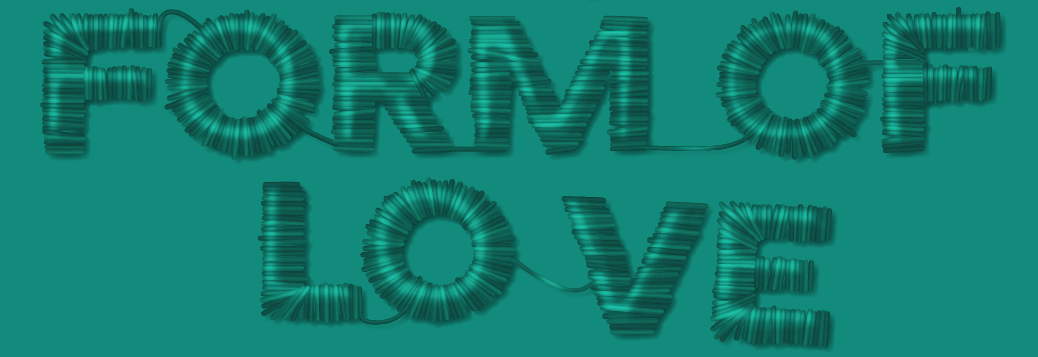
I had been thinking of the text floating on top of the fabric, but Padma wondered if I could embroider it. Or, she was thinking about me maybe finding a font that looked embroidery-ish rather than just flat. I did find a font that did that, but I figured if I was going to go the sewn-lettering route, I should go all the way and create it myself.

Step zero: the font.


Step one: I recreated the lettering on top of that font using vector lines in Illustrator. Each line had a gradient applied to it so that it was lighter in the center and darker on the edges to give each "thread" dimension. There were three different colors of threads. I made sure to leave gaps here and there and threads connecting the letters.


Step two: I removed the font and saved this with a transparent background (the green is just for your viewing) and brought it into Photoshop. There, I created three layers of the same lettering with three different levels of brightness. Then I did some erasing until my lettering was dimensional.


Step three: I did some painting and erasing to create a shadow under the edges.


Step four: I added a texture, much like I did with the fabric.


In this blog, the above probably look like incremental changes or even, between some, no change at all. I lose a lot of resolution on the images I post in here. But I dropped the updated lettering into the Illustrator file, popped back to Photoshop to add some wrinkles and shadows to my fabric, and  in the end, when we finally had our cover, author Padma was so pleased she sent me the most lovely note.

It's stunning: eye-catching, original, evocative, luscious. All the little details with the threads pulling out!?!? The textures and wrinkles! It's my favorite kind of metaphor: it has obvious surface appeal and increasing rewards each time you revisit. 

I can't believe how lucky I am.

Which I share not to pat myself on the back, but to mention how beautiful to me those last few words are. "...how lucky I am." For some reason that comment just stuck with me, how special it is to hear someone say that about something you've made for them. Because it's one thing, a fantastic thing, to be told something you've made is good. It's so much more to be told that it has made someone else feel lucky.


Like Every Form of Love's American edition will be out soon. More information on Padma Viswanathan is here. More information on publisher 7.13 Books is here. Here's a taste.

*

Phillip was buff, with hollow cheeks and expressive blue eyes: flinty or inquisitive or fonts of loving kindness by turns. There was nothing femmy or camp about him, yet he affected a performative masculinity in public, brusquely calling security guards and checkout clerks “man” and “bud.” In private, he unloosed throaty, symphonic laughs, blasts from a rogue angel’s trumpet. (God, I loved his laugh.) He’d locked that hard body around a tender heart.

His defences dropped quickly; after that trip to the city, he pursued my friendship. My other project in this time, though, was a three-day fast (either confronting or avoiding my then-life’s most urgent subject, my disastrous marriage—I’m still not sure). And as my mother had told me, a food fast is traditionally done with a social fast. She used a Sanskrit word for it, maunam, silence.

Phillip didn’t believe in it, not like the fast conflicted with his beliefs, but like he couldn’t absorb the fact of its existence. He wanted me to come thrifting with him; he wanted me to taste a delicious cookie he’d bought. I caved on all counts. I had only a few days left in Genoa Bay, and was charmed and intrigued. He was so different from my other friends. His courtly manners, opening doors for me and making me walk on the side of the street away from the curb; the way he spoke, in a thick BC lilt, his speech peppered with “fuck” the way others use “like” or “um,” using colourful, unfamiliar idioms I’d repeat to myself and write down later. I heard the stern, brass-knuckled poetry of the dangerous classes in his waxings-on about his main topic, the pursuit of rough sex, “the game, the gay game,” as he put it.

After his haircut in Victoria on our first time out together, he ran a hand along his new fade and mused, “Maybe I’ll find me a long-haired motorcycle dude, with my soldier’s buzz cut.”

He told me he hadn’t been sure how I would “take the whole homosexuality thing, being straight . . .”

“And Indian?” I guessed.

“Well, yeah,” he admitted, “of the culture. But I used to work at a pulp mill, and all the guys there”—Sikhs, I supposed, since they’d been stalwarts in BC’s lumber industry for generations—“they’d be having sex with women, men, everyone. I’d get to know these guys and get to know their dads and go to bed with them.”

Stories: he had a million of ’em.


Monday, December 18, 2023

Book Cover: The Sign for Drowning

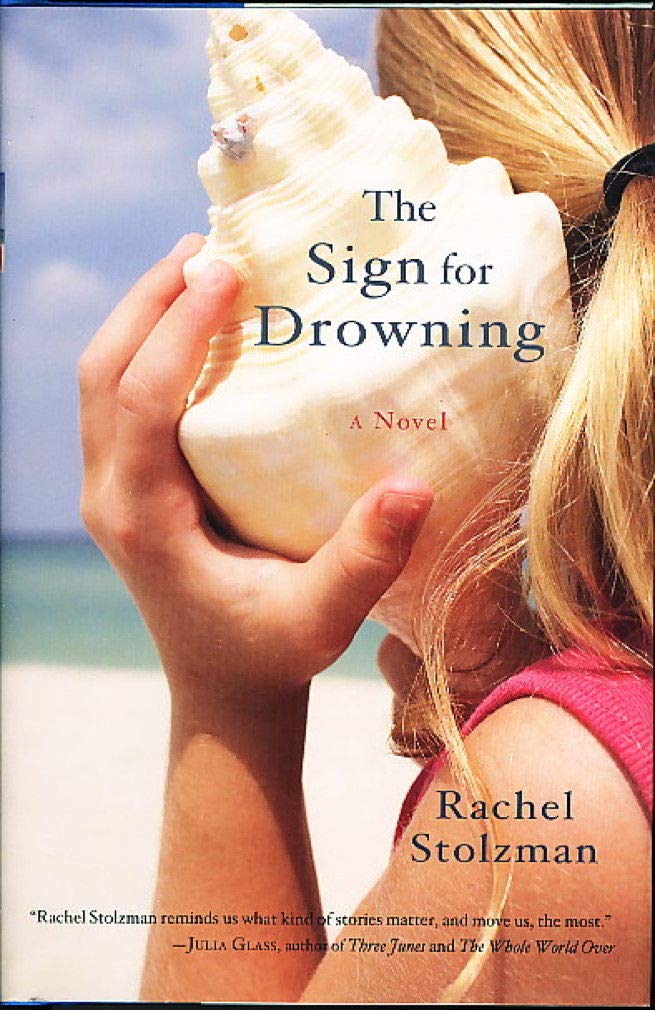
This fall I had the good fortune to be contracted to design two different book covers for two books for one of my most favorite presses, 7.13. One was The Sign for Drowning by Rachel Stolzman Gullo. The novel originally came out in 2008 from Trumpeter Publishers, and this is its reissue. Publisher Leland Check had these succinct words to say about the book when he reached out to me:

It's a terrific novel about grief, about the Deaf community, written quite beautifully.

In the story, the narrator, who is a teacher to Deaf children, is haunted by the death of her sister, years earlier, to drowning. Here's the original cover.


To start things off on this new edition, Leland had Rachel give me some thoughts on covers and cover elements she liked. She shared an article on book cover trends and said:

This article speaks to me and I like the idea of handwritten large title and flowery stuff- flowers symbolizing ephemeral. We might play with imagery in book from the The Little Prince. The flower enclosed in a fence. Or not. I had a review in the Sarah Lawrence magazine that used the African violets that Adrea falls for…

Also, here’s covers I find beautiful.


She also shared this image that she thought might make an evocative cover:


In some book cover design projects, I come up with or am given a concept and run with it, working on that one design until it's good. In many projects, I work through two or three concepts in rough form, show them to the clients for feedback, and when the clients choose their favorite, I refine from there. With The Sign for Drowning, I shuffled through many different concepts, creating and showing, creating and showing, until we finally zeroed in on what spoke to Rachel.

I started with her notes on liking big, hand-drawn lettering, flowers, specifically African violets, and her idea of drawing on The Little Prince, which is a book that figures in her story.  With the African violets, I scattered them across water, floating the lettering, which I hand-drew, on top. For the Little Prince, I experimented with the single rose from the story, swirling the stem and threading it through the lettering, and in this instance my reference to water was a single drop hanging from the flower.


When I shared these rough drafts with Rachel and Leland, I also mentioned that I thought the photo of the hand dipping into the water might be a little too on the nose but that I could certainly try it. I reminded then that these concepts were in their early stages and that I'd add things like texture and detail down the line if they liked where I was going with it.

Rachel said:

Wow! It’s amazing to see a new cover coming to life! I like the rose one quite a lot. I’d be very interested to see you add texture and detail and how it develops further. 

I like that there’s something off or mysterious about the long circular stem and just one rose. It makes me curious. 

I can’t help but want to see one version with water, but I hear you about on the nose. 

BTW- My last name has a Z in it- Stolzman. Hope that doesn’t change everything- just kidding!

OOPS.

Also, I'd obviously gone too subtle with the water in my African violets design (there are rings around some of the flowers, but you can't really catch the nuance from the images that show on this blog) and she couldn't tell it was water at all.

Leland said:

Yeah, I also really like the rose direction, and the idea of incorporating water in some way into that design.

I’m open to photography and testing it out. But to me, the rose is a winning direction. But it’s Rachel’s book and therefore, her cover...

So I stuck with the rose direction and added water to it. Of course laying my swirl of stems and leaves in water meant I should remove the drop from the rose. I also replaced the simple, single-layer leaves, which were mostly just three or four leaf shapes that I'd reproduced, with individual leaves with multiple layers of detail.


Seeing this new version, they began to rethink, wanting to move toward something more somber. Rachel suggested I read a certain scene in the book and look for concepts and elements there.

So I tried a new handful of ideas. The sister's drowning death happens from a yellow blow-up boat, so I thought about a tiny yellow boat, alone, in a wide field of water. I tried the violets again with fewer of them and more water. I on impulse one day created a scrappy, sketch-like version of the hand-touching-water photograph. Because the scene Rachel suggested I read has the narrator by the ocean at night I created two concepts in that vein, one highly playing on the phenomenon of bioluminescence that the narrator experiences in the scene. Within these concepts I tried different layouts and fonts, including more hand-drawn lettering.


As before, these were unpolished. I could, for instance, try adding some texture to the hand-lettering to make it look like it was, say, drawn with a pen. But that would happen after a concept was chosen.

In the end, none of these concepts were chosen. While we went back and forth on a few designs, particularly the bioluminescent beach, honing in on that idea, Rachel shared a painting her cousin Faye Stolzman made, that was quite lovely.


I tried a sample or two using it.


And suddenly we were off on a new direction. Rachel and Leland really liked the painting, and we tinkered with it (I played with layout and Rachel asked me to try some different fonts)...


...until we settled on a design. 


The problem then was that the photographs Rachel was able to get of the painting were not high resolution. Faye was still working on the painting so we gave her some time to get to a place she was happy with and then she took some more, higher-res photos. Once we got the images, the shoreline and, more importantly, the clouds had changed and the lettering didn't fit the same way, so I did some photoshopping to combine a couple different passages along the long painting to create the space I needed. Also Rachel was interested in me trying some hand-drawn lettering again, and some more versions with the font, so there were more samples back and forth.


In the end, she zeroed in on the version she liked best. It's interesting how far we came from the elements and concepts I started exploring in the beginning, but I'm so happy we found a cover that Rachel could love, and one that uses beautiful art from someone she loves. The Sign for Drowning is a book ultimately about human connection, and with the cover, we got a human connection we hadn't bargained on.


The Sign for Drowning is out now. It can be purchased here. And here's an excerpt:

We have been reading The Little Prince. Not the usual image of a mother reading to a child. We face each other. She watches my eyes and my hands. Adrea is deaf as a stone. She says that I named her.

Our first contact was a spring day in her classroom at the Huntington School. I frowned at the stained rug, ripped books, bare barred windows. Frowned at the eight special foster children. Her rounded tense back suddenly curled against my shins. She was sitting on my feet, facing away, holding herself. An introduction.

I looked down at this unfamiliar five-year-old child, her head resting on my knees. Her hair was neatly parted down the middle, braids curving down each side like rivers rushing to reach the back of her neck. Lowering myself to the floor, I was careful to keep my legs steady and not jostle the girl. She spun around, placing her small feet on top of mine. She wrapped her arms around her knees, looked directly at my face and then away. I read her name tag and signed, “Hello, Adrea.”

She pursed her lips tentatively, broke into a smile. Two rows of perfect baby teeth. Slowly she brought out one grubby hand, signed carefully, “My name is—” then in a rush, “Adrea,” as I had.

I’d skipped a letter, a loose fist, two fingers over the thumb, two fingers under the thumb—N. We’d made a truce, unknowingly, that would be permanent.

I put aside the book. We need to talk about a flower that loves. Adrea wants to know what I believe. God, I need to know her every belief. We agree a flower can love, so can a plant and a tree. Lying on Adrea’s bed, the sun boasting and rain tapping down, hands that talk, flowers with heavy hearts, what possibility would I dare deny?

Surely there’s some scrap of bible that a stone overheard.

Now she’s Adrea. I’m the mother who never conceived. She is the child who entered this world soundlessly, as silent and swift as a drowning. But I must not think of these things together.

Sunday, February 20, 2022

Book Cover: Please Be Advised

A really fun project I had this winter was designing the book cover for Christine Sneed's next book, Please Be Advised. It's an epistolary novel of sorts—except that instead of being written in the form of letters, it's written in the form of office memos. Here's how it was described in Publishers Marketplace:

Grace Paley Prize for Short Fiction winner Christine Sneed's Please Be Advised, pitched in the vein of Dear Committee Members, a humorous novel in corporate memoranda chronicling the implosion of a “miniature office products” company through the work lives, extracurricular relationships, and dubious business strategies of its employees.

And here's something Christine mentioned in an email to me, that I think is an even better, deeper description of what this book is all about: "...my overall goal was to write a book that expressed the absurdity and accidental sadness of office culture, i.e. how nuts it is that many of us are forced to spend most of our waking hours doing jobs we don't like alongside people who, in most cases, we don't like much either."

When we first started working on the concepting for the cover, Christine shared some of these memo pieces with me, and they're witty and clever and hilarious.

Christine suggested that the cover, like the book itself, be constructed of memos, and of course this was perfect. In my head it was one memo for the title and one for the author name, arranged askew and with some office detritus scattered around. I pictured the cover as an organized mess, reflecting the "implosion" of the office world Christine had created.

And maybe there could be some particular object sitting on the main (title) memo. "A coffee cup," I tossed out to Christine and to editor Kurt Baumeister, "a bunch of crumpled paper, one or more of those miniature office products mentioned in Publishers Marketplace... Is there some funny element that could be hanging out on top of the memo? Spilled coffee?"

When Christine wrote back to say she liked the way I was thinking, she shared one of the specific memos from the book, and it was all about spilled coffee, and it was so good that I went all in for the coffee spill concept.

I started by arranging some pieces of paper and my husband's overturned coffee cup on the cutting
board in my kitchen and taking pictures of it. Then I got on illustrator and recreated the pages and the coffee cup. See, this is how simplistically my design work starts. ------->

As I constructed my cup I was thinking on how best to arrange it all: memos, title, author name, coffee cup... where might a blurb go, where does the book's subtitle want to be? What other remnants of office life want to be included? I thought about the edge of a keyboard but that felt too overpowering. A lot of the challenge of this cover was balance. Enough of the coffee cup has to be in the frame that the viewer instantly identifies it as a coffee cup, but then does it overwhelm the more important elements of title and author name? Make the coffee cup smaller and it doesn't look realistic against the size of the paper. Add the edge of a keyboard and you likely don't have any place for the blurb to go.

I constructed some small objects that could evoke office without taking away from the important stuff. A pen.


A paperclip. 


And finally I started arranging my elements to match the layout that was in my head.

My first color scheme was lots of reds and blues. And browns, of course. That's another interesting thing about balance. You have to puzzle together the balance of the colors. And it's more than what colors fit well together in a space. Sometimes you have elements that guide the color. A coffee spill means there's going to be brown. The main text being in the form of memos means those spaces are going to be lighter colors than the text on top of them. Which means you need a strong color for the background. Here were my first couple samples.


Christine and Kurt didn't love the coffee spill sort of blurring and obscuring the author name, so we scrapped that. They both chose the layout I liked best, which is the one on the left with the blurb up top. Putting the subtitle on the pen was fun but the other layout worked better, so that's the one we went forward with. 

Christine said she didn't love blue, so I started to think on other colors. And while I was experimenting, I got a note saying, what if it were a martini glass rather than a coffee cup, to reflect the fact that, as Christine described it, "this novel has a drunk malcontent as a main character and quite a bit of raunch too."

Then things got interesting.

Alright, things were already interesting, but think about the new challenge of creating an object of glass, spilling a transparent liquid, out of simple colors and shapes. And what would this do to the balance of color, especially with the paper no longer being blue: would we have whites on whites on whites? What would this do to the balance of the layout, now that whatever was behind the martini glass would be partly visible?

I didn't have a martini glass in the house to position into my scene at the called-for perspective so I started to scour the internet for pictures that could. Then I went back to my shapes and lines to create the glass.


Shades of white on white on white made the martini glass disappear too much (unfortunately I didn't keep any samples of that, that I could show here) so I decided to experiment with light yellows for the pages and hints of blues in my grays for the glass and spill.


I stayed with reds and reds for the moment, and of course with a martini comes an olive, so that added a bit of green (although too bright in the shade I have it in, in the above). We had to lose the second pen because it competed with the shape and smaller footprint of the glass.

I liked the yellow for the pages. It definitely brightened things up a bit in a design that had been looking a little heavy, colorwise.

Once I got the martini glass to work, it was just a lot of small adjustments as I talked back and forth with Kurt and Christine, and then later got thoughts from Leland Check, the publisher. Playing with colors. Moving and enlarging the subtitle. Playing with the text of the memo that shows behind the glass. 


And in the end they chose the iteration that they liked best, and we switched out the blurb for a mention that Christine is a bestselling author and a prizewinner, and we had a cover:


Please Be Advised will be out in October of this year. More info on 7.13 Books is here. More info in Christine Sneed is here. And enjoy a very funny excerpt from the book below.

*

INTEROFFICE MEMORANDUM

Date:   September 12

To:       All Quest Industries Employees

From:  Ted Kluck, Junior Partner, Gounes and Flinderman LLC

Subj:    New Doughnut Policy


This memorandum serves as your formal notice that forthwith and without exception, all doughnuts that appear in Quest Industries’ communal spaces must be shared with everyone. Quest doughnuts may not be thrown into the trash due to someone’s punitive relationship with food, hoarded at anyone’s desk, or resold on the neighboring streets to children and dimwitted tourists.

This memorandum does not serve, however, as an endorsement of doughnut-eating in general. Doughnuts are widely considered by licensed nutritionists and other healthcare professionals to be a source of empty calories, if not an outright danger to one’s health due to the manner in which they cause one’s blood sugar to spike and subsequently plummet with life-threatening swiftness.

We are cognizant of the fact they are extremely delicious treats, but nevertheless advise you to consume them at best infrequently and with humility.

Please direct any questions about this matter to President Bryan Stokerly’s executive assistant, Hannah-Louise Schmidt, not to me, i.e. Ted Kluck. This is my last day in Chicago for the foreseeable future, as I am heading to Washington, D.C. where I will be serving on a federal grand jury focused on corporate malfeasance, offshore banking, red light camera abuses, money laundering, and rooftop gardens.

Thank you for your attention to this matter.

Sunday, February 13, 2022

Book Cover: House Fire

Recently, I had an email from Leland Cheuk, the publisher of one of my favorite small presses, 7.13 Books, asking if I had time in my schedule to design a book cover. All he said in that initial email was, "It’s a special one!"

Leland's promotional text for the back of the book explains it best:

From an automaton navigating a forbidden relationship with a man in post-apocalyptic Australia to a reimagining of a friendship between Franklin Pierce and Nathaniel Hawthorne, Nawrocki’s short fiction ranges from futuristic to historical and everywhere in between. House Fire, the winner of the 2009 James White Poetry Prize, judged by Mark Doty—a book that was never published—blazes with poems that are erudite and precise, even when confronting the messiness of love, grief, and mortality.

The work of the late Jim Nawrocki, who died of cancer in 2018, is poignant, rangy, and genre-bending, and House Fire is a debut collection from a literary voice gone far too soon.

So, a special one, indeed. I've never before designed a book cover for someone who wouldn't see it. I definitely felt the tension of that as I experimented with colors and shapes and lines. And what a tragedy that the original book never happened for him in his lifetime. But how lovely that, recently, when Jim's partner Jason approached Leland with a pitch for finally making this book happen, Leland said yes. 

Jason had two thoughts about the possible design direction. First, he shared that when Jim's book was initially going to be published, Jim had suggested a famous piece of stencil art by David Wojnarowicz for the cover. "But after 12 years," Jason told me," and a Whitney retrospective, it might be too popular now. (Also, I think another book used it for a cover design in the past year or two...)"

Then Jason shared that another image that had been talked about for the cover of that original book was an old photo of two men that Jim had picked up somewhere, an antique store or a bookshop: "Jim had always projected onto the photo the idea that these two gold rush-era men were lovers or partners of some kind."

I loved the photo—and the back side even appeared to have the names of the men on it.

But I did worry about copyright issues in using it outright on a book cover. Even with antique photos, copyright stuff can be a bit of a minefield. And then I saw that the image was too small to reproduce well in print. 

But I started thinking. Why not combine both of these directions into one? Why not make a stencil of sorts out of Charlie and Roy's picture?

I started by drawing lines around the various areas of the men's forms and creating shapes in Illustrator

After I had created Charlie and Roy simplified down to just three colors each, I worked on a couple layouts incorporating title, author name, and place for a blurb. And added some stencil-like texture. The lettering I played with was a stencil font, which I figured I'd refine and make more my own if they decided they liked that direction. My original idea for color was reds, oranges and yellows—fire colors.

So, okay, it's a little harsh on the eyes.

Tarantino-y is what Leland called it when I sent him the samples. 

He said he and Jason liked what they saw but were interested in a softer, more obviously historical tone. "The stories and poems are wide ranging," Leland said, "contemplative, about art and history and gay identity. There’s a level of erudition in the work as well. Would love to see something a little softer to reflect that."

To get more of that historical feel, I chucked the stencil font and played with adding a decorative border. I experimented with different color schemes, including shades that could evoke a sepia tone. 


They liked the border and the sepia-like color scheme, and we refined it further. Bringing the colors up a little brighter. Trying a very deep red for the main text.

When we finally had a finished cover we loved and I started writing this post, I asked Jason for a little more information about the James White Poetry Prize, the book that hadn't happened, and the path it took to become the book it is now.

"I actually read about Leland and 7.13 in an article/blurb in Poets & Writers magazine," he said, "which Jim was still receiving for a bit after his death. 

"After reading more about Leland’s journey, I wrote him a heartfelt email (taking a chance to stray from the usual query letters I saw Jim had used for many of his past submissions) about how similar their journeys seemed to be, with one major exception—Jim didn’t make it through his illness.

"I felt like I needed to do this for Jim, to finish his life’s work ❤️❤️❤️ As I wrote to Leland, who wouldn’t do something like this for someone they loved?"


House Fire will be out in the world on May 18th. More info on this and other 2022 7.13 titles is on the 7.13 Books site here.

And here's a little sneak peek from the very first story:

*

Severin Park was, almost literally, a work of art. The creation and crowning achievement of Chansen Soo Park, the eccentric, reclusive, and infamous cybernetics genius of Seoul, Severin had been the world’s first fully functioning automaton (to use the archaic parlance his creator preferred). He was virtually indistinguishable from a human, but for the strange and almost ethereal cast of his skin, which Park père had fashioned from a mysterious kind of advanced ceramic, durable and specially developed for his robotics work.

Severin had become a celebrity of sorts. He’d been deliberately gifted with a combination of a face and physique considered both unusual and attractive. Seen often at art and fashion-world fetes, he had more or less stumbled into a kind of side career as a model, appearing in several high-end European fashion magazines. He’d had some roles in films in what had been called independent cinema. He was even something of a playboy; his creator had also taken care to endow Severin with not only the functioning anatomy required for physical intimacy, but the desire (albeit a moderate one) to use it as well, and there hadn’t been a shortage of women, or even of men, who coveted the chance to earn a turn in Park’s bed.

His wealthy creator had appeared indifferent, at least publicly, to the unusual life assumed by his handiwork. His only formal statement on the matter had been a manifesto, which, true to his preference for old technologies, he published in a limited edition and expensively produced letterpress book On the Moral Autonomy of Automatae. As its title suggested, one of its proposals was a radical addition to the system of Linnaean taxonomy, a recognition of cybernetic creations and artificial intelligences as worthy categories of “life.” The manifesto was quickly reproduced on electronic media and available to everyone. It was widely read and debated at the time. While it was clear that the inventor had used his considerable wealth to finance Severin’s emergence into the world at large, it was also evident that, after a certain interval, the quasi-human being he created had been able to support himself and live independently. Park and his creator had little contact after that threshold had been crossed.