Showing posts with label brave on the page. Show all posts

Tuesday, January 15, 2013

brave on the page at powell's city of books

Every Portland writer dreams of reading at Powell's City of Books - not to mention plenty of writers across the country. What a cliché to say, but it's true. I had the chance to be part of an event there in 2009 when Portland Noir came out. Though I wasn't one of the readers, I got to hang out at the table and sign books afterward, as a contributor to the collection, and it was definitely one of the thrills of my writing life.

Last Monday, January 7th, I read at that podium as part of the Powell's event for the book Brave on the Page. It was an incredible event in many ways. The lineup was...wow. Reading from their essays in the book, along with me, were Kate Gray [Another Sunset We Survive], Gina Ochsner [The Necessary Grace to Fall], Robert Hill [author of When All is Said and Done and a personal writing hero of mine] and writer / editor / publisher / powerhouse Laura Stanfill. After the readings, writing guru Joanna Rose [Little Miss Strange] moderated a panel on writing, process and creativity with Jon Bell [On Mount Hood], Kristy Athens [Get Your Pitchfork On], Scott Sparling [Wire to Wire] and Yuvi Zalkow [A Brilliant Novel in the Works].

Jon - Robert - Scott - Kristy - Laura - me - Joanna - Yuvi


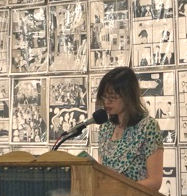
When we gathered for a photo afterwards, Kate and Gina were lost in the crowd and we couldn't pull them over, but here's most of us - framed by a wall of black and white comic book pages. When you think about reading in the Basil Hallward Gallery in the Pearl Room of the City of Books, you have to wonder what art show will serve as your backdrop. I loved this. It was nearly floor to ceiling.

Robert Hill

We had a wonderful, enthusiastic crowd of approximately 150 people, including local writing luminaries like Tom Spanbauer, Stevan Allred, the recently-Oregon-Book-Award-nominated Carter Sickels. And one of the coolest things to me: so much of this crowd was writers. I suppose that's to be expected when the book is about writing and the essays speak to the writing life and the panel is all about craft - but as expected as it was, it still made me very pleased, so many of us gathered in one place to talk about this thing that is sacred to us.


Kate Gray
I really liked the mix of essays chosen for the event. Kate Gray's "Shiny Object, Shiny Object" was full of great suggestions for writing and getting the job done, all of which I [wish I could] adhere to. "...After an hour on a bike, the focus on one-foot-two-feet, spin-spin-spin, everything else falls away. And I am balance and shift and friction..."

Gina Ochsner
Gina Ochsner spoke about the very particular issue of cynicism and what it can do to our confidence, our writing process. "...If I allow cynicism to drum with the heavy hammers of no good, no good against the tympanic membrane, I hear the winter wren in the dark hemlock behind our house. I can't recognize the beauty of its song nor appreciate the fact that the smallest, plainest birds compose the sweetest songs..."

me
Again, it was a nice mix - because Kate and Gina's essays spoke about process and craft, Robert Hill and Laura Stanfill's essays combined writing topics with personal stories, and mine was a purely personal story - one that, when I lived it, had been full of shame and, when I read it last Monday, got a surprising amount of laughs from the audience. I love when the stories of your life do that:

"...Ring of the phone, his voice in my hear, high, almost feminine: 'Can I share something?'

"It wasn't really sharing since he'd only called to read me a story he'd written, and he didn't really want to know what I thought unless I loved it.

"Sometimes I didn't, but I hated to disappoint people..."

Robert's "Why I Write Out Loud" is about words - about sound and texture and cadence - but is also about family. "...I grew up on stories told at bedtime, told on car trips, told at the dinner table, after dessert. My mother told these stories, five or six of them, over and over, in rotation..." and "...Every syllable of these words told in my mother's raconteur's voice full of wit and Brooklyn inflection I loved hearing, every entertaining sentence told again made the usual silence of our family bearable..."

Laura Stanfill
Laura Stanfill's "Overnight" describes the writer / mother dilemma, Laura lying in bed, waiting for her daughter to fall asleep so she can get up and write her novel. But this tiny essay is so much more:

"...The boy in my novel gets diagnosed with a weak constitution, and he believes what the doctor says. He stays in bed. He reads and rests. He wishes. My daughter rolls over, tilts her chin up, breathes deep. She started kindergarten this fall. The shift of her world has begun. Someday both my girls will leave the house without me. They will be broken apart by small things. I tell stories about brushing teeth, drinking milk, getting enough sleep, instead of filling pages with lace and music. Someday my girls will choose whether or not to be good to their bodies..."

Joanna Rose
Sadly, I can't include a bit of voice from Scott, Yuvi, Jon or Kristy, since their portion of the event was all off the cuff, not in any book for me to refer to. But it was such a terrific panel. Funny, fascinating, just the right length. Joanna Rose led them through such topics as dealing with holes in writing, "fact vs. truth," and the benefit of writing groups - illustrated perfectly in a story Joanna told in which, while workshopping a scene with the Pinewood Table writing group, Scott Sparling learned that women in showers do not squat to pee.

Kristy Athens - Jon Bell - Scott Sparling - Yuvi Zalkow

These guys were great. Every one of them. And after the formal panel, Laura brought all of us back up front for a Q&A, taking questions from the crowd.


- A little goofing with the mic, which didn't quite reach me in the very center of the group. It was an honor to sit in the middle of these smart writers and try to keep up with the great questions and answers.

I said it was an incredible event in many ways, and another of those is the support Brave on the Page has had from Powell's. Forest Avenue Press is a very new press, a micro-press, yet here we were with a big event hosted by the City of Books. Also, the  books are printed just one floor down on the Espresso Book Machine. I think Laura Stanfill has something really special going with Forest Avenue Press, and the support she's gotten says loads about not only Powell's and the writing community in Portland but also - and most of all - Laura's energy, ingenuity, and smarts.

Laura Stanfill
After it was all out and over, Laura had this to say in an e-mail of thanks to all the participants:

"I keep thinking about reading in the Pearl Room as a dream come true and how it came true in a richer, deeper, more powerful way than I could have imagined. And nobody in New York made it happen, no agent or editor or outside party. We made it happen. Together." 

*

To order Brave on the Page from Powell's Books, click here.

To check out Forest Avenue Press, go here.

FAP is now accepting submissions from Oregon authors writing "quiet novels." To submit, click here.

Monday, December 17, 2012

being brave on the page with sarah cypher


I've met [in person and cyberly] some really great writers through my involvement in Laura Stanfill's book Brave on the Page. One of them is writer / editor Sarah Cypher, of the Threepenny Editor.

After Laura introduced us via e-mail we started a bit of an e-conversation that grew and spilled out over a few months. We're very different writers. She excels at speculative fiction; I like to stick close to my own life for inspiration. She puts lots of planning into a project before she starts writing; I... don't. Sarah is full of great writing wisdom, as her interview in Brave on the Page can attest, and our e-mail thread has started to feel like a companion piece to that book. Here's some of what Sarah has to say.


The big picture vs. language in writing interests me, and I don't really have a rule for it. I'm reading Blood Meridian right now, and Cormac McCarthy is so much about the language - the novels would be hollow if the narrator did anything less than put the weight of the universe on our shoulders. Yet on the other hand, I see manuscripts that give so much loving attention to the language, but it doesn't deepen the story. There's some X factor that makes language and story click together in one novel, and in another, not.

and...

What I try to do in fiction is set up an idea, a what-if that is compelling enough to engage the reader and get him/her listening hard between the lines. If a reader isn't willing to listen for what isn't said, then it's hard for a story with any kind of subtlety at all to work.

Process is a very individual thing. Mine tends to be pretty fluid and unplanned, with the best of my writing often coming from something quirky that pops off the top of my head. I was interested in hearing more of Sarah's process, especially since she is not only a fiction writer but an accomplished editor of others' work.

My process probably errs too much on the side of planning, but it's been helpful nonetheless. Speculative fiction, as a really broad genre, gives me a chance to pick and choose disparate elements from the world, ones that resonate for whatever reason in my imagination. Then I spend a long time guessing at why, and trying on a bunch of conflicts that might tease out that same resonance in a good plot. 

For instance, I've been looking at cyberwar, natural disasters, and gender identity for a next novel - huge topics that suggest a dozen different kinds of conflicts. There's a mysterious, crooked note that runs through them in my mind, and I've done a lot of reading and research to figure it out and capture what's human and emotional in it. It's the listening phase at the beginning of a new project, and it usually ends up being the emotional chord that I try to hit in the story's big, turning-point scenes. 

Then I've got a whole plotting system that works 50 percent of the time, and it helps me cobble together an outline that I sometimes follow, sometimes tear up.

Sarah's having a plotting system really intrigued me. Do most writers have systems they follow? Probably many do. My system is to write down some quirky thought that came into my head and amused or intrigued me and then just start writing and see where it goes. Lots of tearing up happens in that system, too, but it happens along the way of the story. Which system takes longer? Which system makes for a better finished product? I think it depends on the brain. I have a hard time wrapping my brain around story if I'm not wrapped up inside the story and inside the voice of the narrator. When I do try to plan beforehand, I feel like I'm running underwater. I don't really get anywhere until I give that up and start writing.

I'm a visual thinker, so I like to see my arc, my scenes, my subplots, and my theme. I also run my ideas through Lajos Egri's premise / protagonist / antagonist system [The Art of Dramatic Writing], and the young adult tool for identifying your hero's controlling belief. Sometimes I think about Joseph Campbell [The Hero's Journey]. They're all ways of panning for gold. Sometimes, though, I'm like you: I just write to the best of my ability and see where the words find depth, and follow that. It's definitely the scariest exercise.

You wouldn't think of writing as a scary thing. When editor Laura Stanfill first floated Brave on the Page as an idea for the title of her book on writing, my thought was, yes, writing is a place where you can be brave. You might have been that kid who ate lunch in the library and ran away from the volleyball [perhaps I've admitted too much, here], but alone and safe with a page and a pen, you can be brave. The more I thought about it, though, I realized you can take that phrase, brave on the page, a number of ways. Sometimes the being brave isn't what you can do but what you must make a concerted effort to do. In our e-conversation, Sarah and I found ourselves talking a lot about this.

To me, being brave is just a test of faith: that your idea matters, that your story matters, that your intuition is alive. I do a lot of planning at the outset, but it is helpful only so far - usually as a trail of breadcrumbs to follow if I lose my way. It's also a way of helping knit research together. I almost always change the plan as I'm writing, but the goal is to do it from a position of creative confidence, an informed discovery that I was wrong about something, and that my character is developing well enough to point it out to me. Otherwise, I just feel like I'm blowing with the wind, and that eats away at my courage.

Bravery in writing comes in looking at that blank page and finding something to say. Bravery in writing comes in creating something and hoping to god it's good. It comes in opening up one's secrets, one's sore spots. It comes in spending hours and weeks and months and sometimes years on a project and knowing that what lies ahead is a string of rejection letters. It comes in choosing a plan and sticking with it even though it's so hard to know what will yield the best results:

Plotting everything out beforehand can clear some likely territory, but for the most part, now that I've just thrown myself into writing a huge chunk of this current novel by intuition alone, the fear of the unknown scenes ahead corners me sometimes - I don't want to waste months working on scenes that don't work. But when I compare that to the fear of being no good at all, the fear of wasting my time and my hope, the fear of where the story is going seems positive - a challenge, rather than a put-down.

I think that's the key, really. Finding the fear that's the most positive, the most productive, and sticking with it.

*

Check out Sarah  Cypher's blog here - and the Threepenny Editor  here.

You can buy Brave on the Page here on Powell's.com

Sarah wrote her own blog post in response to our conversation, and you can read it here. 

Sunday, November 4, 2012

getting ready for the reading


book plus lovely scarf laura
knitted me as a thank you for
designing the cover - part of
my outfit for the afternoon
I'm getting myself ready for the Brave on the Page Reading and Launch party. This means practicing my piece alone in my writing room, sitting on the couch with Nicholas on my lap, reading with the door closed even though Stephen's away, at work. This means taking my shower and doing my makeup, then taking Nicholas out for a walk, reciting memorized bits of my essay quietly under my breath as we walk down a sidewalk scattered with wet leaves. Reciting. Reciting. Stopping whenever I see a dog walker up ahead so they don't think I'm nuts.

I iron my blouse, get dressed. Do my hair. Take special care that it curls under on the bottom, curls back on the top, spray it with that stuff.

When I get back from Powell's after picking Stephen up from work, as soon as we walk in the door, Stephen says, OK, put the curling iron on.

Oh yes, this was always part of the plan. I'm no fool.

Les Lunettes, Stephen O'Donnell, acrylic on panel

You don't marry a man who paints himself in dresses and elaborate hairdos without taking advantage of his talents, especially if you're a woman with no sense of style whatsoever. Early in our relationship, I used to get defensive when Stephen wanted to fix my lame attempts at primping, but by now, we've gotten to that place in our marriage where both of us simply agree that it's just better to do the job right. I press the button to start the curling iron warming up again, and we consult on jewelry, stacking bracelets and earrings out on the table.

Before we get started on the hair, Stephen glances at my blouse and his face does that crumple thing that means he's politely letting me know that though I made a valiant effort, some assistance is in order. I take my shirt off. He goes and gets the iron.

Alas, sometimes even Stephen can't keep me on task. Re-ironed and re-curled, re-dressed and happily dolled up, I grab my book and am out the door to the reading - leaving the array of carefully-chosen jewelry behind.