Showing posts with label writing. Show all posts

Sunday, February 16, 2025

a moment in the life of my book: style guide

My publisher has sent me the copyedits for my book. It's another of the steps on the way to this thing becoming a thing. Seeing it in my inbox gives me one of those whooshes in your body that you can call excited and you can call nervous and I'm going to call excited. Along with edits to punctuation and spelling and suggestions to wording, is the copyeditor going to have found plot holes that I won't know how to solve? My book is, among other things, a mystery, after all. Every step along the way, I've worried about how easily a mystery, like any knitted blanket, can come unraveled.

But first, look. Something I've never received before. The copyeditor has done a "style guide" for my book. Wow! This is a document that informs the choices the copyeditor makes, that can guide the publisher and author as they respond to those choices, that can guide the proofreader once a book gets to that step in the process, but for me, it feels like a gift. Seeing the file name turns my knitting metaphor (I don't even know how to knit) into something bigger, turns my blanket into a flesh and blood being, and opening the style guide is like opening up the results from an Ancestry DNA panel.

And look! Here's a section of the style guide called "word and phrase list." These words and phrases are my words and phrases. I believe they're chosen because each can be spelled or presented more than one way and the copyeditor is designating just which way they will be presented on the page, but this funny assemblage of words tells a little story about my story.

aha
bull's-eye
card sharp
déjà vu

And somehow even most exciting of all, she's put together a list of "character notes." Here are the names of all my main and important secondary characters with a paragraph, each, of description. The people I created, listed out for me, as if they're real people, even with the odd names I gave them. One the Gun. Two the True Blue. Three the Goatee. 

And I don't know why, but the fact that she's put this list in chronological, instead of alphabetical, order makes my nerd heart sing.

Friday, December 27, 2024

a moment in the life of my book: thumbs-up

Rain is soft on the roof and I'm sitting at my desk, working through the latest iteration of the manuscript of my novel for my publisher, Laura Stanfill. I recently did a pass on the book primarily focused on catching any places in the story where the continuity is off or where any of my details don't quite jibe with my classic noir era time setting. Did they really put whipped cream on milkshakes back then? Probably not. Was the phrase I used in this bit of dialogue actually in use at the time? I don't think so. When I finished going through the novel, I sent that pass, with my comments and proposed changes, to Laura, and now she's sent the manuscript back with her comments and her decisions on my proposed changes.

I scroll through the manuscript, accepting changes as I go. All down the right-hand side of the computerized pages are our comments in little talking bubbles labeled with our names. 

One of the features that's new to the Microsoft Word reviewing pane—or at least that I maybe never noticed before—is that you can put a react on a comment. See there? In the corner of the talking bubble where I explained why I want to cut a phrase from a paragraph, there's a little thumbs-up. And if you hover your cursor over the thumbs-up, another bubble pops up, labeled "L Stanfill," with one little word, as if you need it explained further: "like."

She likes it! OK, then. I click accept.

It's such a pleasant, relaxing process, after all the hard editing stuff, to just scroll and accept, scroll and accept. I trust Laura's opinions implicitly, one of the many reasons I'm so glad she's my publisher.

But I start to notice. There's a little "like" pop-up bubble that isn't going away. I scroll to the next comment, accept another change, scroll further, but that little "like" bubble keeps following me around.

I hover my cursor around the bubble to look for an X I can click. There's nothing. It must be some little likey glitch. If I were working on the internet, I'd hit refresh. That would do it. But I'm working using my desktop app.

I let my cursor mosey around the bubble again, trying to find an X again. Nothing.

I'm sure if I press save and then close out of the Word file and reopen the file, it will disappear. 

I don't know. Maybe I won't. What harm does it do, bobbing along, over there at the edge of the page? I kind of like it. It's as if, no matter what, there's a hint of Laura following along, telling me this book is good. And I'm going to need to feel that as the pressure mounts, as we get closer and closer to the birth of this novel. So, I scroll and accept, scroll and accept, and the "like" bubble joins me on my way.

Monday, March 4, 2024

a moment in the day: forward

It's writing group night and my friends and I are Zooming, ready to read aloud from our pages and critique as we go. Our pages have been sent out through email and each of us in our little bubbles, me at my house, Holly at hers, Shannon at hers, Brian at his, sitting down at our computers, are bringing up each other's pages to read. My pages are left over from last week because last week we ran long. Which means I get to read first tonight. It also means I probably should have resent my same pages out to everyone this morning, but I was lazy and hoped they had them saved from before.

"Everybody got them?" I ask.

"Yes," says Shannon.

"Yes," says Holly.

Robin is in her car, driving home from work, and her Zoom square is just her photograph, silent, as she listens in, on the road.

"No," says Christy, looking through her email for the resend that I didn't send and should have.

"I'll resend it," I say. And I do. But instead of making a new email and re-attaching my pages, I just go to my sent box and find last week's email and do a reply-all forward. See what I mean? Lazy. I know full well that sometimes when you forward an email the attachment doesn't attach, but that's what I do anyway.

I wait a bit and then:

"Everybody got them?" I ask.

"I got the email," Christy says, "but not the attachment."

Which means all she got is an email saying "Yeppity yep." Which is all I'd said in the body of my original email last week because when you're sending pages to each other every week you don't want to have to try to think of something new and coherent to accompany it every time. See what I mean? Lazy.

Now everyone's talking at once. Doug saying he got the attachment, Brian saying that resending the email should pop the original to the top of the inbox, me saying I'll resend, Christy saying that's okay, she'll do a search for the original. I see the top of her head on her Zoom square as she hunts via her tablet, and I'll admit: it starts to feel a little like a race, me against Christy for getting her the pages. 

"OK, OK, I found them!"

"Alright, alright, I found them!"

Christy wins. I should organize my computer files better.

Now Brad, momentarily away from his desk, comes back.

"Everybody got them?" I ask.

Brad's clicking through his inbox: "All I got is 'Yeppity-yep.'"

Zoom chaos as everyone's talking at the same time once again. Brian saying look for last week's email. Brad saying he will. Me saying I'll re-resend them. Christy saying she'll forward them.

And Christy and me, we're in a race again, and now we're racing Brad scrolling for last week. 

"OK, sent."

Christy wins again. 

But Brad says he doesn't see it. 

"I'll resend it," Christy says. And does.

Still Brad doesn't see it.

My inbox is full of my pages.

"I'll resend it," I say, again, again.

Doug says, "You should label it Yakety-yak."

I say, "Don't talk back."

I see the top of Christy's head again, and quick, I navigate to the folder, attach the attachment, resend the send, and finally, finally something comes through to Brad's inbox.

He says, "Yakety-yak."

Brian says, "Don't talk back."

And if we do that, if we all stop talking, we can begin reading. I click back to my pages on my computer screen and ask for the final time, "Everybody have them?"

Brad says, "Now I got all of them."

We laugh. We settle in to read. After all that, this better be good.

Sunday, December 10, 2023

a moment in the day: shore

(I wrote this back in the summer, sort of as a way to help process what had happened, but I didn't feel comfortable sharing it, so it just sat in the queue. Stephen and I were talking about this time and I remembered the post, mentioned it to him. He said, why don't you share it. So I am.)

It's a Sunday, not our normal day, but my writing group, the Gong Show, is meeting in my backyard to do a little special critique work on one friend's pages. We call ourselves the Gong Show because we always start the session with a strike of a gong or singing bowl, a sacred musical object, and Brad has brought a gong with him. It's small, the size of a dinner plate (you should see the size of the one in his basement), and it has a loop of chain through it, which he uses to hang it from the slats of a small side table not far from the big table we're all sitting around. 

Brad has also brought along a copy of the book The Remnants, by our friend Robert Hill. To add a little extra bit of the sacred to our opening ritual, before we start in on our workshopping.

It's been just one day since we learned that Robert has left this earth. It's been nine days since my good friend Mara, who I knew since I was six and she was four, left this earth.

Left this earth, a convoluted phrase. But I can't say died. Not right up close to their names like that.

Our way of talking about death is often about traveling through space: left this earth, passed on, departed.

When Mara was in the hospital and we were spending every day there, going back and forth from home to walk Nicholas, Stephen and I would walk the long hospital corridors mostly in silence. One time, he asked me, "By now, if you were alone, would you be able to find your way?" 

Through the maze of hospital halls to the tiny waiting area where our group of family and friends routinely camped out at the edge of the ICU, going in and out of Mara's room, visiting, sitting while she slept, bearing witness, keeping vigil.

Short answer: "No." Not with my horrendous sense of direction. But then, walking, Stephen and I came toward yet another intersection in the pathway, and I tested myself like always: do we turn left? And getting closer, I saw that left led to a doorway, so no, we don't go left, we go right.

We turned right and kept going.

"Actually," I said, "maybe. Because every time we come to a crossing, it seems like there's a short way and a long way, and we have to take the long way."

That phrase stuck in my mind as we walked: we have to take the long way. It seemed to really be saying we have to do the hard thing. But it could also be saying we all have our own particular journeys to take, however lost we feel.

Now, in our backyard, the Gong Show writers sitting around our backyard table, Brad is flipping through his copy of our friend Robert's book, looking for the passage he wanted to read to us. A crow swoops over the lawn and lands on the birdbath, dunking its beak in the water. 

"OK," Brad says, and clears his throat that way he does that sounds like a small, sudden explosion. He reads:

"There is a shore we see from the distance when we are young and we think we are the first to see it and we are the only ones who know it is there, yet as we near it closer and closer it gives way to a shore more distant that is the real shore we are born to want to reach. It is the shore that made the first cave dweller leave the comfort of his cave and his cousin the spear wielder find in the air a reason to do more than just live; it is the far shore that drew to this spot, this New Eden, the men and women who made what they could of the time they had here, and who traveled from here to an even more distant shore that no one will be left to recall."

Traveling, moving, going forward.

Brad closes and sets down the book, hits the gong.

Sunday, June 11, 2023

Some passages from my journals about my good friend Robert Hill

Robert Hill was my second close friend to pass away in a very short period of time, and I've been looking through my old journals for stories I wrote down about both of them. I compiled a bit of a post with excerpts for each of them, and this one is for Robert—a sadly inadequate and incomplete collection as my journaling is scant at times, especially in these later years full of projects and not enough time. But I'm thankful for the memories I did write down, and I thought I'd share for anyone who's missing him.

Some commentary and explanations in italics before the entries. 

*

This took place at the home of Tom Spanbauer where I and some friends were in his Dangerous Writing workshop. The "outside group" I mention is a small writing group threesome of Steve Arndt, Kathleen Lane, and me, that we were talking about expanding, and which eventually became the Henry Writing Group (because we met at the Henry, across the street from Powell's). Diane and Dian are different people, not a typo. I honestly can't remember whether I had met Robert by now. It's the first mention of him in my journals.
Friday, February 22, 2008, 2:25 PMPages went wellrewrite passedof course, Diane wasn't there. 

And outside, we were talkingKathleen, Steve and meabout the outside group. She's spoken to Robert Hill, who's interested, and she wants to invite Dian.


Just a tiny snippet about when I started reading Robert Hill's first book When All Is Said and Done.
Thursday, February 28, 2008... 2-28-2008... nice10:28 AMFinished Now is the Hour yesterday morning and have started Robert Hill's book.

Lots of voice. I've already come across good humor and sadness and social issues.


This was a writing retreat the Henry Writers took together, and Robert used the time to work on a story he was writing for the book Stephen and I were producing, The Untold Gaze.
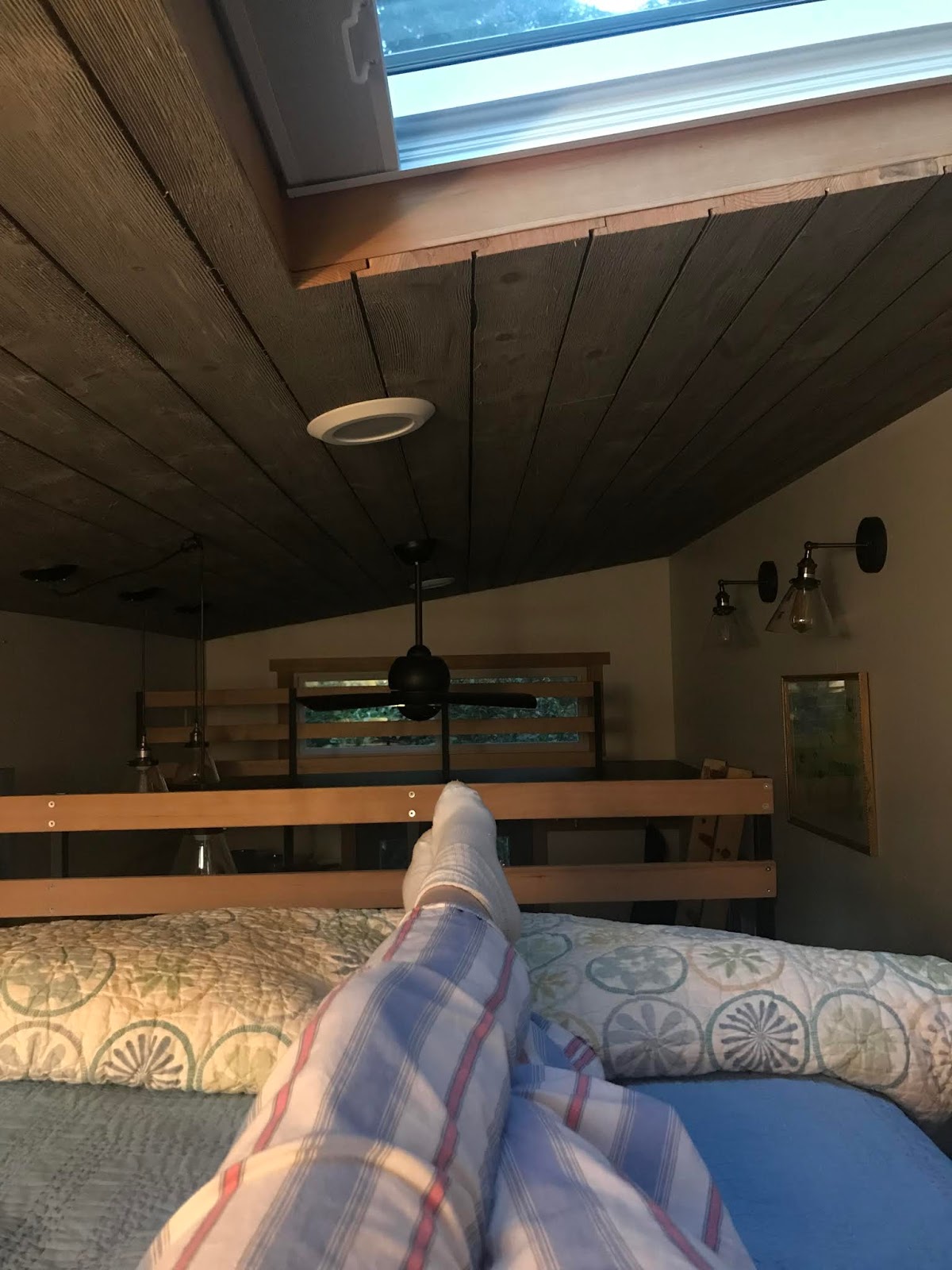
Monday, October 20, 2014, 4:05 PMLovely day-long writing retreat at the Tiny House. It was Liz, Kathleen, Robert, Sara and I, and the house was lovely. I spent most of the writing time up in the loft bedroom, which was so low you had to crawl across the floor to get to the bed, and the roof was a steep slant over your head. It felt cozy sitting on the bed with pillows and a window at my back. Sounds of frogs through that window. And geese. Geese were flying over constantly. At one point, I sort of stretched and craned my neck back and upside-down saw so many geese fly across the sky. Lovely sounds to write by. That and the occasional giggling of Robert just about directly below me in the great room. Giggling to himself about the piece he was writing for Stephen’s book. In the end he told me he was a little over the limit. “You wanted 600 words, right? Mine’s…” squinty-eyed face, “eleven hundred.”


Snippet from Henry Writing Group.
Wednesday, October 28, 2015, 9:41 AM—Laura surprised us all with the opening to a new book, and Kathleen surprised us with a piece from a whole book she’s written in a month and a half. Both were amazing. Robert with a gorgeous new early piece to his new book, which was very different and added so much to the story. Sara with an essay on rape, which was strong but which we were able to give her a lot of good feedback on. Which she’s writing for a submission to an anthology headed up by Roxane Gay. Dian with a great story she wrote in a garden in France. Liz with a rejection letter for her memoir that she wanted feedback on. It was a night of being enriched in the company of some of my favorite people. And inspired.


More writing group. The reference to "poeh-treh" is about a performance Stephen and I did at the Poe Show, but what I love about this entry is that it was the first time Robert saw copies of The Remnants, his second book, which Forest Avenue Press published and whose cover I was honored to design.
Wednesday, January 20, 2016, 2:20 PM—had Group last night to fill my soul up again. I read for the first time in months. It felt very pedestrian and not that interesting, but I just wanted to get them back on track with the reading and me back on track with bringing stuff in. All evening, Liz, Steve and Robert kept talking about “poeh-treh” and laughing and talking about how good we were. Liz said as soon as we finished performing, she stood up in applause. “And I hate standing ovations!” she said. Robert walked me to my car afterward and asked me where the inspiration for Lord and Lady Bungalow came from. So funny that it just popped out of our mouths while driving around, on the way to Cape Meers that early trip when we found Bayocean and didn’t get swept away by a tsunami. Laura brought the first copies of The Remnants, hot off the press. She gave Robert a copy of the Poets and Writers that has the piece on Forest Avenue Press and followed it up with pulling out six copies of the book and handing him one. The delight on his face. So fun to watch him look at the actual book for the first time. A couple times I caught him just sort of lightly petting the cover like it was a delicate bird. 


Then the wrap-up of Robert's Powell's book launch for The Remnants.
Friday, March 18, 2016, 10:24 AM—Well, Robert’s launch was a lovely night. Looks like there were at least 75 people. The party at Liz’ beforehand was very nice. Stephen and I met Wes at the call box, and that was a lovely surprise. There were maybe 25 people at the party, and then Group had the front row for the reading, which I think was nice. Stephen and me, Kathleen, Steve, Liz, Dian, Sara (Margaret was out sick but just found out she was one of the runners up for the PEN, which is amazing), Laura, of course, Norm. Stevan Allred. Brad came, which was nice. Jamie, sitting alone in back. Liz was the intro, which was fabulous, and Robert gave a lovely tribute to Tom, which I told him about in my letter. Robert had flowers and/or presents for folks he was thanking, and mine… I sat on the floor and opened it with Kathleen and Steve and inside… so clever. First I unwrapped what looked like crackers and I thought, OK, where’s the cheese. It wasn’t until I finished going through it that it occurred to me, and I said to Kathleen, no, this is just like in the book! Tea and saltines! He gave me two tea cups and saucers, tea and saltines. And a sprig of apple blossoms which—he searched for… what is it in the book… cherry blossoms? But this was a good substitute. He really had the crowd laughing as he read. Stevan likened it to Shakespeare, how at first, you’re a little lost in the language and then you click into it and it becomes this understood, beautiful language you ride, and I think it’s true—the laughter just built. 


Another snippet from writing group, this time on Zoom, with a mention of the next book Robert had been working on. (The "poor mouse" is something a crow left in our birdbath, if you must know.)
Wed, May 12, 2021 at 12:08 PM—I had Henry group, which was just Liz, Robert, Steve and me as Kathleen, who was supposed to join us at the beginning and then the end, couldn't get back on at the end. I only saw her for a moment as she was getting off (I was a little late because of the poor mouse). Robert read the end of his book, which was amazing, and Liz read the beginning of a new project. So it felt like a momentous meeting. We talked and talked about just the last few lines of Robert's book, and it felt like a privilege to do so. 


Finally, here are Robert's final words from the final email I got from him. I wanted to share them, not because he mentions reading the book I've been writing, but because I like to picture him there, sitting outside, just enjoying some coffee, and goofing around, beautifully, with words like always.
It's going to be 88 here today. It's glorious out. I'm sitting on the front porch with my coffee looking at a haze of sage pollen waft across the driveway just in my sight line to a cluster of daffodils across the road.

Bugs are buzzing, an owl is hooting, in the distance several dogs are engaged in an a cappella argument.

I have barely had any clarity to work on STUCK. Maybe 4 pages in the past 3 weeks? Ugh. But... I am looking forward to devoting a church of outdoor time today to diving into your book because it's so charming. And so you. And so therefore attention must be paid! Wait... Willy? Is that you? Are you home from Albany? The boys have a bone to pick with you! What? Lunch with the mayor of Providence? How... special. I made meatloaf for dinner. Digestion must be made.

Thursday, August 5, 2021

a moment in the day: half

Writing group night. We're meeting on Zoom again. We met on Zoom starting all the way back in March of 2020 and through until the last of us was fully vaccinated this past June. Then it was a lovely two months of meeting in person, sitting together, talking, hugging, laughing. But now Delta is surging, young kids still cannot be vaccinated, and there's new understanding that even those fully vaxxed can spread it. So I and my friends are back to growing our proverbial victory gardens: masking, zooming. Doing what we can.

As our Zoom squares start to fill up my laptop screen, mine looks wrong. Stretched out like when you try to watch a movie with the wrong aspect radio on your TV. The stretching pulls everything thin like my face and the wall behind me are vertical lines with tiny lines of space in between.

"Do I look weird to you guys?"

They say I don't. But on my screen I'm stretched thin, and I find I have to shift all the way to the right side of my computer in order to see my whole head and shoulders centered in my square.

"Gigi," Doug says, "you're half out of the frame."

I'm stretched so thin that half of what they can see I can't see and half of what I can see... Oh, I don't even know, but I shift back over to where the tiny dot of camera at the top middle of my laptop can catch me full on. Now everyone can see all of me but I can only see half of me, one eye, one shoulder, half a head.

As my friends catch up on the week, I peck around Zoom trying to figure out how to fix it. If I'm stretched so wide am I also stretched some top to bottom? Like, if I see my head are they just seeing my neck or something? I hunker down a bit. I click over to Google and try to look up the problem.

"Gigi," Doug says, "now I can only see the top of your head."

I abandon Google, straighten up. What I look like on here isn't for me. It's for my friends to see me and for me to be engaged with them. So I relax into my half self and join the conversation. 

Are we being stretched thin by covid restrictions? Are we feeling like we live half lives? And in a way: why not? What are we willing to sacrifice? In order to come out of this whole thing someday not only with our health and the health of our loved ones, but knowing that we did our best, our actual best to be the ones who didn't spread this virus around?

Saturday, June 5, 2021

a moment in the day: group

Steve and I walk down the hall to Liz' loft just like old times, just like before the pandemic, heading to writing group together. 

Everything in this corridor looks crisp and new. The bright raspberry-painted wall at the end by her door: is that the same color as it used to be? Every step of this familiar walk, that Steve and I have taken once a month for years, seems both beautifully old-hat and utterly new somehow.

I push open Liz' door and we walk through. Voices inside. My breath swells against my ribcage. This is our first non-Zoom meeting and my first unmasked, undistanced gathering since the before times. I hurry my step down the short front hall and then here we are—Steve, Liz, Kathleen, me—all fully-vaxxed, all crowded together at the edge of the kitchen doing something we haven't done in so long. Hugging. 

Liz' black curls tickle my face. Kathleen holds too tight and too long and too wonderful. I don't want to let go. 

When I do, she tells us she and her son hugged so hard once that it started to cut off the circulation in her neck and, still mid-clasp, she told him, "I think I'm going to pass out." And did.

Stories bounce back and forth between us as we move into the living room where Robert is waiting remotely on Zoom from his home out of town. "Robert!" I say. His face so small on the little laptop screen.

I drop my bags and take the plastic container of appetizers back across the room for warming in the kitchen nook where Liz and Kathleen have returned, chatting as they try to work the top off a bottle of pink wine. I come around behind them at the counter. Their backs to me. 

"No, we used to do it all the time when I was a kid," Liz is saying. "For fun. Like all the time."

"And there's that thing," Kathleen says, "where people do it for a sexual high."

I pull the top off my tupperware container just enjoying listening to snippets of their conversation. I realize they're still on the ways in which cutting off the circulation can make someone pass out.

"There's a name for that."

"Autoerotic... asphyxiation."

I dip my head in between them. "So, here I am, my very first unmasked, undistanced get-together, and what are we talking about? Autoerotic asphyxiation."

And this might be—not sure but might be—even better than the hugs. Laughing together in person again.

Sunday, November 1, 2020

Book cover: Dispatches from Anarres


I'd been nervous about starting work on the book cover art for Forest Avenue Press' next anthology Dispatches from Anarres: Tales from Portland Authors in Tribute to Ursula K. Le Guin. I'm always very invested in every book we put out, but with Dispatches it's even more so. It's a subject I love, edited by an editor/writer I hugely admire. There are stories in here by other writers I admire. Also, I'm always extra invested in the cover of an anthology because the book doesn't just belong to one writer; it belongs to multiple writers. I want everyone who has a story in it to love it. To compound all this, one of the people who has a story in this book is me.

Back when I was delighted to learn that my piece had been accepted, the publisher of the book had not yet been decided. Then suddenly it was Forest Avenue Press. Which meant I would be designing the cover too. Yay! Eek! Yay! I'd been ecstatic/freaked out ever since.

Then one day an idea came to me like a bolt from the blue. The blue being the shower, which is where a lot of ideas are born. At the moment the thought came to me, I hadn't even been actively mulling the book's cover. It was early to be getting started on that particular book, and I was busy working on a couple others. But it was sort of like the cover art was hiding inside the book title the whole time. Dispatches from Anarres. My mind suddenly flashed on some sort of otherworldly communication tower on another planet beaming stories out into the universe.

I jumped out of the shower to get the idea down. You'd think I'd draw out some simple sketch I could present, but my creative brain works in kind of a weird way. I write and draw with my left hand and I do graphic design (or anything with a computer mouse) with my right. I feel like my left hand knows how to turn line into picture but my right hand knows how to build. Design work, for me, is a lot about building. For this Dispatches idea, I didn't have an actual image in my mind—it was concept—and I wouldn't know what that would look like until I built it on the screen. So I got on Adobe Illustrator and, right hand on the mouse, started moving shapes around. 

A communication tower going up into the sky... slanting up... I liked the idea of a slant... a perspective shot seen from the ground, looking into space, some planets hanging around, throw in some text...


Yes, my early sketches are embarrassingly simplistic.

I knew this was definitely not going to be good enough to explain to publisher and author what was in my head. I needed to make the communication tower look more like a... thing. A real thing. So I started building it. Experimenting with what this tower might look like. 


I got kind of obsessed. The more the communication tower became a thing, the more I felt like until all the elements of this cover looked pretty finished, it wouldn't be worth presenting. It would look cheesy and not give Laura Stanfill, the publisher, and Susan DeFreitas, the editor, the right immediate experience of what the cover idea wanted to be.

I'll admit, too, that tinkering with a shiny piece of sci-fi machinery and creating a spacescape was a wonderful distraction from all the myriad worries of our current dystopia. I needed a distraction so badly. I couldn't stop. I didn't stop until I had a tower I liked and stars and planets and a first pass at a text layout. I sent it to Laura and she had some thoughts about the text and I did a little tinkering and she sent it to Susan.


Susan had some great thoughts on where to take it from there. She reminded us that some of the stories in the collection take place on Earth (Oh yeah... including mine.) so she'd love for one of the planets in our spacescape to be Earth.

She also wanted a fantasy element added so that readers would know immediately that there are fantasy stories as well as science fiction. Her first suggestion was to weave in a fantasy map in some way. That got me super excited because what lover of fantastical fiction (or historical fiction, for that matter) doesn't love the map you see when you open the book before you even start reading. 
.
I had the thought that the signal tower that nearly cuts the book cover into two halves could be the dividing line between sky and map. I pictured the Earth on one side and the circular compass rose of the map on the other, mirroring each other

I started with a crude-ish map and refined as I went. Working, I felt giddily like I was following in my brother's footsteps. He has a whole world he created, along with histories, king lists, words and words in languages he made up. And maps. Across years and years, he created beautiful, intricate maps.

Mine was to be only a hint of a map against the sky once I turned it a bit, dropped it into the cover art, and gave it the right transparency. Too much detail would just disappear. So I stayed fairly simple, but as I refined, I changed out earlier crude suggestions of buildings for slightly more detailed castles and things. 
I didn't want place names to be generic and I also didn't want them to point to one story over others. I thought, why does it need to be in English, anyway? So I made up a bit of alien tongue and put that in with my landmarks.

The map was a cool idea, but I worried that the end result looked a little busy. I sent it off for thoughts. Susan agreed about it being a bit busy and had another suggestion for getting fantasy in there: a dragon, or dragons plural, flying above. Ursula K. Le Guin, she reminded us, used dragons as a metaphor for the imagination. These could be simple silhouettes, dark shapes blotting out the stars.

"And I think," she said, "that might actually work in terms of a narrative impulse behind this cover as well, because the tower/ansible is clearly sending some urgent message out there to the stars—having the sky (subtly) infested with dragons seems like it might suggest what the trouble is…"

I loved that. And I loved that she used the word ansible in her comments. The word was coined by Ursula K. Le Guin in 1966 in her book Rocannon's World, as a device, "which can speak instantly to other worlds, with no loss of years." Though it was Le Guin's creation, which she used in different books through her career, the word made it into the greater science fiction lexicon and has been used by lots of writers since. Here's a webpage I found that gathered citations for the word ansible in the Oxford English Dictionary.

Anyway, I pulled the map out and went to work making some silhouette dragons. And as I was arranging them in the sky, I also added some more rings to my ansible's communication beams, fading out into space. There was a lot of back and forth with Laura and Susan over the text placement and then we finally had a final cover.


OK, this isn't a final-final cover. There's one detail that will be changing. You might notice the blurb in the upper left-hand corner is just a stand-in. We'll have to add that once review copies have gone out and blurbs have come in.

Dispatches from Anarres comes out in the fall of 2021. More information is here. And more information on editor Susan DeFreitas is here.

Here's just a taste of one of the stories, this one from "The Kingdom of the Belly" by Michelle Ruiz Keil.

*

The ghost cats live in the neighborhood where they died. Regressed to the we of the kitten pile, they nest in the roots of towering firs, soothed by the murmur passing through the fungal web that laces the urban forest.

When the moon is full, they speak as one, piercing the skin of the night to defy the coyotes, those fanged, merciless gods.

Hate! the cats hiss. Hate! Hate! Hate!

Spent, they wane with the moon. One or two drift off. No one knows where. Most just pretend at predatory things. Airborne, they chase birds whose blood once filled their mouths with pleasure. These cats know they’re foolish. The birds don’t even see them. Pleasure is for the living.

Saturday, November 9, 2019

a moment in the day: pages


We're at the literary event, and they're about to announce my name. When they do, I'll get up and take these pages in my lap to where the microphone is, and I'll read my piece.

Tomorrow we've got an event that's even more involved, one Stephen will be singing in, one he's been making a beautiful, intricate costume for. Which he hasn't finished yet. In the car on the way over tonight, we were talking about events and how you can still get stressed after all these years.

"And why?" he said. "It's supposed to be fun!"

"I know!" I said. "I mean, I may mess up, but who cares? I've messed up before, and it's been fine. All that matters is that we get out there and we have a good time."

And we do. Even with the stressing, it's always fun. This is the thing we tend to forget when we're busy worrying over will we get there on time will the costume be done will I stumble over my words will I lose my place will I drive around twenty minutes looking for parking will I read poorly will no one laugh at the funny parts will someone come up to talk to me and I won't remember their name will I trip on my way to the microphone and fall on my face will my pants fall down.

That never happens. Your pants never fall down.

And here's the thing. If you have fun no matter what goes wrong, what can go wrong?

At the front of the room, now, the co-host calls out my name. As the audience applauds, I head on up.

She hands me the mic and I turn to the audience. Big grin on my face.

"Hi!" I say. I hold up my small stack of pages: the lifeline and security blanket of every writer. "So, before we get started, does anyone have my first page?"

Saturday, July 13, 2019

five days at moss rock retreat


Stephen and I don't give each other presents as a rule. We used to get together and, in a joint venture, buy some movies on DVD, but in recent years we haven't even done that. But this year, I turned fifty, and he gave me something special. A five-day writing retreat in a tiny house, all by myself, just me and my book, at Moss Rock Retreat.

Oh my gosh, what luxury. I've written through a couple drafts of the novel, have done a lot of workshopping, which tends to make you see your book in bite-sized pieces. So I printed the entire thing and took it with me. For the first three days, I read and made notes. Tried not to stop the forward momentum by doing too much editing, just jotted down what needed to be done, and then after I'd read through, I started back at the beginning and edited according to those notes, on computer.

I loved the experience and the place so much that I wanted to share some pictures and some details. Writers in and around Portland, Moss Rock Retreat is right here in Portland, within walking distance of the lovely Leach Botanical Gardens as well as a wetlands trail that I took on the second day while taking a break from my work. It's a tiny house in the middle of a gorgeous garden, and it has all the amenities so you can just hang out and work.


The reason for the name. Here's what owner Virginia Bellis Brandabur says about it:

We're calling the tiny house "Moss Rock Retreat" after the big boulder that can be seen from the porch. It's one of the boulders created 1.6 million years ago from the Mt. Scott shield volcano eruption. Half a century ago, the city dug up the boulder from under the street when they put waterlines into this neighborhood. Now it's one of my favorite things in the yard.


The tiny house! It has this sweet little porch. Sometimes I brought my work out onto the porch and sometimes after a day of working or editing I'd come out onto the porch and just relax.


At the end of the tiny house, inside, is a little writing desk where I set up my computer when I first arrived (although I moved it around a lot). There's wifi access, which was great because I was working through some logistics in my novel and was happy to be able to have access to information.


On the other end is a little kitchen with refrigerator and freezer (good sized), sink, oven, stove and dishwasher. There was everything I needed to cook and eat on, pots and pans, utensils, cups and glasses. There was olive oil and salt and pepper. They left me some eggs in the fridge from their chickens! And if you look to the left in the above picture: yes, that's a washing machine. I was amazed at what they fit in this place.


They left me flowers!


Appropriate coffee cup.

Oh, there was coffee and tea and things to brew them in. And amazing knives. Towels, pillows, extra blankets, all the things.


A tiny library with both good things to read and good reference books for writers.


Here's some tiny house ingenuity: storage drawers built into the stairs leading up to the sleeping loft. One thing to note: I was the first visitor to Moss Rock Retreat, as they were still in the process of getting things up and running. As you can see, the steps currently don't have a railing. Owners Virginia and Matthew are in communications with a woodworker to create the best type of railing for the space and aesthetic of the house. They're continuing to improve the space as writers provide them with feedback on their experience.


I have to say, I holed up in the tiny house for much of the retreat, sunk deep in my book. But I did take a walk along the wetlands trail one day and I did spend some time out in the garden that surrounds the tiny house. It's quite a large garden you can maze your way through, with a bunny hutch, a vegetable garden, lots of beautiful flowers and trees, and a very friendly cat.


And chickens!


I found this sweet little out-of-the-way spot to set up and work for a while.


The view from there: sky with butterfly.


I was joined by this guy. His name is Comb-over.

The owners of Moss Rock Retreat, Virginia Bellis Brandabur and Matthew Brandabur (and their two great kids!) were lovely and accommodating. They made me a sweet hand-made map to the wetlands trail. Alone in the tiny house, it felt good to have the family nearby and accessible should I need anything (I was also car-less for the week) but they gave me my privacy and would text when they were going out for the day in case I felt shy of wandering the grounds when anyone might be around. One night there was a huge storm and the power went out in the neighborhood for a couple hours. They brought me tea candles and an electric lantern and I relaxed with one of the books from their library.

In the end, not only had I done a whole lot of work on my book, but I'd had a lovely experience in a special place. I highly recommend it for writers wanting to get away and really commune with your work. If you want more information, you can email them at mossrockretreat@gmail.com. Or visit their Facebook page at https://www.facebook.com/Moss-Rock-Retreat-470633856837960/

By the way, Virginia Bellis Brandabur is also one of the hosts of the Lilla Lit literary series that happens at Leach Botanical Gardens. If you're lit-minded in or near Portland, it's definitely something to check out. I loved their spring event, and will be reading, actually, at their summer event, on August 18th. More info on the series is here.


Home. Time to unpack.

Thursday, November 2, 2017

From my kid diaries: a recording of the first short story I ever submitted - with the spelling errors intact and my commentary in blue


The one change I made to the entry is to put the story itself in italics rather than all the quotation marks I have in my diary, because it gets a little confusing.

*

We got 2 Hitchcock magazines in the mail and I turned imediately to the “Mysterious Photograph.” It is a sort-of contest they have every month. They put a picture in the magazine. You take that picture and write a story (250 wds or less) about the picture. The winner gets $25 and the story apears in the next Hitchcock magazine.

Well, it was a picture of 4 people on a rocky island. One is fishing.

I took the magazine to the computer room, wrote up a story, and set it with the magazine in Mom’s room, where she was napping.

I wrote:

“Cast it over there, Starkey." I instructed, pointing to the left of the tip of a rock that jutted out of the water, "It’s in a little box."

I sat upon the rocks. The island was in the middle of a large bay, and it consisted soley of rocks and boulders. Starkey stood above me with a fishing poll, carefully casting and recasting the hook into the water; I sat below him, shouting directions; Manfred and Buffalo paced behind us.

Starkey lowered the hook, and it sank into the water, once again, with a quiet "ker-plop."

He dragged it around for a minute and then brought it out again, bare.

“I can’t Whitey." Starkey groaned. (He always told me that he called me Whitey because of my perfectly straight, white set of choppers.)

Sure, stealing all those jewels was simple, but when Manfred rowed us to the little island in his little rowboat, we lost the box over the side as we docked. Now, I could not leave until we found that box. Our Pal, Nicky, would be here to pick us up and take us down to Mexico tonight; I had to find that box before then.

“You have to." I retorted, "We’re not leaving until you do."

God knows, I couldn’t leave without my toothbrush.

Mom loved it. I was so glad. As soon as I revise it as much as I can, and give it a title, I’m going to send it to the magazine.

*

I like how I was so proud and sure of this story that I printed it out and took it into my mom's room while she was sleeping. I'm sure she proofread it and made me change all the spelling errors before I sent it out. I honestly don't remember what kind of a response, if any, I got from Hitchcock Magazine

Sunday, October 1, 2017

a moment in the day: done. kind of.


I skid the chair back and get up from the desk and go downstairs but I don't know quite what to do with myself.

It's three o'clock and I haven't showered and I haven't eaten. I need to eat because I promised Stephen I would make one of the eggs our neighbor brought us from his very own chickens. Also, what do you know, I'm starving.

I go down to the basement and pull out a bottle of Veuve Clicquot. A lovely Christmas present. The bottle is sheathed in its own bright orange box. I take the box up the stairs and into the bedroom and take a picture of it next to the movie we will be watching tonight, even though Stephen doesn't know it.


Too Late for Tears, with Lizabeth Scott in the lead and Dan Duryea as Danny Fuller, the weasely tough who she ensnares in her femme fatale trap.

I don't know why I decided to name all the characters in my novel after this and other Lizabeth Scott noir films, but that's what I did, and after working on the book all day, I think I owe it to my characters Lizabeth and Scott  and Danny and Fuller and my protagonist Emmie Pennock (cobbled from Lizabeth Scott's real first name and her mother's maiden name) to watch it tonight.

I put the champagne in the fridge and take the dog out. Nicholas sniffs around the backyard shrubs. The sky is blue and full of big fluffy clouds. I kind of want to cry but that feels silly, so I take Nicholas inside and start making an egg. It's weird finishing a first draft of a novel. It feels momentous even though it's really just a tiny step in a project. The ending might not even stick. Still, it feels like a moment, and every moment deserves a little recognition.

Saturday, March 18, 2017

Book cover design: Alex Behr's Planet Grim


Recently I had the honor of designing a book cover for Alex Behr's upcoming collection of short stories, Planet Grim. Alex's writing is beautifully particular, darkly funny, and deeply moving. I fell in love with her work when I first heard it at a fabulous Portland arts salon called JAM. Hers is the kind of writing that makes you fall in love with the mind that penned the words. Sharp, edgy, quirky, and profoundly real. I thought her publisher's description of the book described it beautifully:

In twenty-eight stories that will draw blood while making you laugh, Alex Behr’s debut collection Planet Grim is a vivid, unsettling portrait of the gritty fringes of San Francisco and Portland, where complicated characters long for connection just out of reach. Behr is an idiosyncratic, unpredictable prose stylist who will remind readers of Miranda July and Mary Gaitskill, and her edge and willingness to cut to the bone make her writing truly original.

"Planet Grim," Alex quipped the other day. "I named it before the election."

The title was actually the source of a lot of mulling for me as I was brainstorming ideas for a cover design. Both words, planet and grim, are quite loaded. Planet, in particular, had me wondering whether it would be good to actually play on imagery of the earth - after all, there's a sense that the phrase "planet grim" refers to both the particular world of Alex's characters and the wider world of all of our lives.

I did play around with some earth-related ideas, even going so far as to, on impulse one day, build myself one of those schoolchild models of the solar system out of dowel rods and Styrofoam balls, for a sample. Never let it be said that I don't like to get down and dirty with my book design.

But I also played with concepts that, rather than focusing wide and cosmic, pulled in close and personal. Which Alex's collection does so well, zeroing in on what makes us human. One very rough sample I offered during the concepting phase used Alex's own beautifully evocative picture of her son in a superhero cape.

In the end, Alex and her publisher Leland Cheuk of 7.13 Books (whose press name I have repeatedly embarrassingly screwed up as 7.15 and 3.17 and π [OK, not π] over and over in my back cover and spine samples) decided upon the sample that they felt got to the moodiness of the collection the best.

Recognize the person in the picture? Here's the original.

That's Alex herself (photo by Lewis Watts) which I did some color and texture work to, then slanted a bit and, obviously, blew up really huge.

For the original rough sample, I created the text in Adobe Illustrator, but Alex wanted something whose execution looked more actually hand-rendered. So that's what I did. I got out my paints and brushes and recreated the lettering on an acetate overlay. Here's a very bad picture of that acetate piece, which I only include here because look at the cool shadow it made on the wall when I  took the picture!


In the end, I liked the texture and painterly-ness of the hand-rendered lettering but the smooth edges of the vector art, so I photoshopped the two versions together. It was a fun process which gave us, finally, a finished piece that we all liked. I hope it's a cover worthy of the beauty and uniqueness to be found on the inside of the book.

Here's a taste from the story "White Pants."

I held up the white pants in front of me, judging that they’d fit. They had rhinestones down the sides. I ducked into a bookstore to put them on. It was next to the café where the Mission’s Red Man sat all day, his face covered with a thin sheen of red face paint.

I put on the pants, forcing up the zipper, and followed a girl who also wore white pants. I followed people for sport, not loneliness. She had bleached white hair, like Debbie Harry, and wore high heels with a white blouse and white pants. All that white blinded me. I felt like I’d met my twin, only someone with more sex trapped in fabric and leather shoes. I crossed in front of blatting scooters and cars, not pausing, knowing the vehicles measured their speed based on mine, and I was matching hers.

I followed her as far as a tamales cart and I let her go. She was looking back at me, and I had nothing to say.


Planet Grim will be out October 12, 2017.

More information about 7.13 Books is here.
More information about Alex Behr is here.


Tuesday, January 10, 2017

City of Weird Contributor: Linda Rand


Kevin Meyer submitted his City of Weird story at the eleventh hour - specifically, twenty after eleven on the very last day of open submissions. I'd like to award him the "Last Submitter" award, especially since waiting until the last moment is my own strategy, but I can't. The "Very, Very, Completely and Utterly Last Submitter Award" goes to Linda Rand, who sent me a Facebook message at 12:14 AM on April 16, 2015, technically fourteen (fifteen? I don't do math) minutes after endgame.

"hi gigi! i hope this isn't a huge faux pas," she wrote. And she explained that she'd had trouble getting her submission to go through on the Submittable page we'd set up. Finally admitting defeat after midnight rolled over, she'd decided the only thing she could do was send the submission to me via Facebook. She looked up my name and sent a message. I didn't know her at the time and wasn't Facebook friends with her. It's very lucky that I got the message at all, that it didn't just languish in my "other" folder, which I don't even think I knew existed at the time.

"I'm thinking this is particularly wrong because it was a blind reading...*sigh*" she said. What she meant by blind is that the rules for submissions specified that submitters were not to put their names on their manuscripts. Knowing that I was friends with many, many Portland writers, knowing that it would be hard to be objective if friends sent me stories, I had asked publisher Laura Stanfill to police my submissions and keep the writers' identities from me. Essentially, we'd said that if a writer put their name on their submission, they could be disqualified. Linda couldn't help but disqualify herself by appealing to me through a Facebook message with her name right there. She pasted the story, in full, into the message.

I'd spent that last night of open submissions working on a book cover design and periodically watching the Submittable page, as there had been more writers than just Linda and Kevin who gave it until the last day to upload their stories. I felt kind of ceremonious and festive on this last night, so I was also posting random images on Facebook for good measure, images of old Weird Tales magazines, like this one: the clutching hands of DEATH.

Here's my hastily-jotted commentary from my diary the next day:

A fun night. Periodic posting of old, campy illustrations on facebook, and watching submissions come in while I worked on Ellen’s back cover and listened to Suspense old time radio shows. My last submission was from a woman who apparently used to work at the Blue Monk, which I saw on her facebook page after she appealed to me through a facebook email at 12:15ish after her story wouldn’t go through on Submittable at ten till midnight. It’s a sweet, little flash piece.

I remember when I read her piece for the first time, I laughed out loud. Flash was definitely a plus for me. I'd so been hoping for some flash fiction and hadn't gotten much. Another plus, beyond the story being short and funny, was its landmark, the Blue Monk, a bar that used to be on Belmont but now is no more. And her otherworldly element, a gorgon, was completely different from any of the tropes used in the other stories.

And luckily the question of the blind didn't matter. I didn't know who she was. In the end, not only did I take the story, I also gave it one of the eight illustrations in the book, which I made as separators for the anthology's different sections.

Linda Rand is both a writer and an artist. Her artwork has been included in PDX Magazine and the book Oneira: I Dream the Self, curated by Peggy Nichols of Studio C Gallery in the Santa Fe Arts Colony in LA. Her writing has been published in Bluebird: Women and the New Psychology of Happiness, by Ariel Gore, in the anthology The People’s Apocalypse, edited by Ariel Gore and Jenny Forrester, and most recently in the Unchaste Anthology, Volume 1, edited by Jenny Forrester.

Here's a beautifully written story of Linda's up on Nailed Magazine.

Not only all that, but this past year, Linda's been making a human! I mean, how cool sci-fi otherworldly is that!

Here's a taste from her story "Stone Cold Monk." It's hard to keep from including the whole thing since it's so short and lovely, but I'm going to make myself cut it off. She will be reading it in full at American Legion Post 134, Friday, January 13th. The event starts at 7:30.

“Linda, what’s with the Medusa when I walked in? It can’t be good for business.” My friend Vaslav rolls his gray eyes, finding this yet another annoying factor at the Blue Monk. For someone who says he hates jazz and hipsters so much, he still manages to visit me a lot. I note he dyed his hair a becoming champagne blond. 

 “What?” I’m coming out of the walk-in with two trays of fruit for cocktails, balancing the cherries so the juice doesn’t spill. “I’m happy to see you but I’m totally running late.” 

Then I see a stone statue toward the center of the room. Just a guy. A statue of some guy. It looks like he is about to duck into a booth, his hand on the dark table, mouth a perfect O of unhappy surprise. With his 1950s glasses, beard, and skinny jeans, practically a uniform in this town, I have to peer in super close to see if I recognize him. There are no tattoos and I wonder if they would even show, as I stare at each perfect stone eyelash. I decide I don’t know him, but with the lack of color, it is a guess. 

The door to the basement is slowly closing, but before it does, I think I catch a glimpse of drab muslin and maybe scales disappearing into the gloom.

Sunday, November 27, 2016

City of Weird contributor: Jonah Barrett


The note that accompanied Jonah Barrett's submission for City of Weird (which I didn't read until I'd decided to accept the piece, since I was reading submissions blind) contained some really interesting insight into the origins of his story.

While mostly being inspired by all the times I’ve visited Portland with my friends, the story is also based off the Lowline project that’s taking place in New York – an initiative to convert an old abandoned trolley system into a lush underground park using solar technology. The Lowline project was originally called “Delancy Underground.”

"Alder Underground" reads like a transcription of posts taken from a Tumblr blog. I noticed that lot of the old weird fiction tales are written as "found journals," and I thought that a modern day version of that might be akin to something like live-blogging.


Here's some info on the Lowline project. It sounds really cool! Although after you read Jonah's story, you might want to reconsider ever going there...

What really intrigued me, though, was what he said about live-blogging somewhat mirroring the "found journal" aspect of the genre of "weird fiction: (defined as a sub-genre of speculative fiction popular during the late 19th and early 20th century blending supernatural, mythic, and scientific tropes). One of the reasons I fell in love with "Alder Underground" was the voice of that live-blogger, It's a fresh, youthful voice, equal parts sardonic and sweet, and it's the perfect early-Twenty-first century answer to the first person accounts of alien invasions and spirits and monsters popularized by the lovely, pulpy stories in weird fiction.

8:15 a.m. 
We are taking a train down to the City of Roses, or whatever they call it these days. I told Aisha that I’d pay her back for my ticket but I think she knows I’m full of shit. Will buy her a coffee or something as payback. 
#PortlandDaycation #Free triiip #Gonna buy all the bird books

The live-blogging thing was a really fun device, and along with the immediacy that the time stamps brought to the tension, I thought the constant Tumblr commentary by the narrator who is sucked down a water tube into an underground biosphere filled with poisonous newt creatures said a lot about our society today, how we are so obsessed with social media, how we really don't feel like we're living our lives unless we're broadcasting them.

3:41 p.m. 
We have transcended the Weird element and’ve passed on through to the realm of the unreal. I am having a hard time swallowing what just happened—what’s still happening.

Also I’m very surprised that my phone still works.

Here's a totally cool thing: a sketch Jonah made when he was world-building, which he shared with me. It shows the layout of his biosphere and a simple rendering of how it works. I love getting a window into writers' processes, and this was a really neat window into his.


Along with being a writer and filmmaker, Jonah is the editor of The Evergreen State College's literary and arts magazine, Vanishing Point. He also edited the anthology Menagerie, due out next year. It's described as, "a collaboration from over 25 artists and authors presenting 30 illustrated stories and poems about monsters. Subjects include ghost secretaries, lake beasts, anxiety demons, garden mermaids, time travelers, drunk princesses, savage harpies, alien babies, middle school witches, angel hookups, simulated lovers, extinct beasts, and mothers from another dimension."

Jonah says he began work on Menagerie just a month before I put out the call for submissions for City of Weird. Feels kind of like these books are cousins! Keep an eye out in the coming months. Jonah gave me a sneak peek, and I can tell you, it's going to be a really fun book.

Thursday, February 19, 2015

book cover: baby's on fire


Recently, I had the privilege of designing the front cover for Liz Prato's upcoming collection of short stories, Baby's on Fire, due out in May from Press 53.

What a great title. I knew they didn't want actual fire in the design, and I agreed that fire would be too on the nose, but I had an instant thought about what I'd do as soon as I started mulling things over.

Here's the original photo I used for the design, which I found at the very wonderful Morguefile. You'll see I rotated it and added some more to the background and then altered the wisp of smoke at the top. Oh, and got rid of the candle or stick of incense or whatever that is, along with its shadow.


Really, it was three things that gave me the inspiration for the cover design. One was the quality of Liz' writing, and I think you'll get what I'm saying when you see the design. The second was the fire in the title, for sure. Third had to do with one of the elements you find on the covers of most books of fiction out there. I don't know if there's a term for this thing. The tiny text placed somewhere on the design, which says, "a novel" or "stories."

Not long ago, I had some back and forth with publisher Laura Stanfill (for whom I design book covers for her press Forest Avenue Press) about this element in book covers and whether it's necessary, helpful, a waste of space, a distraction from the design or what. Personally, I like it. It's cute and does help a reader know the kind of book they're buying - but mostly I like it because often book designers use it in fun, clever ways.

With Baby's on Fire, I used the tiny word "stories" as, not an incidental, tertiary part of the design, but one of the most important elements of the cover, which I hope conveys the power of these stories. Because it's not just Baby who's on fire; it's these stories.


Here's a sample from the book, to show you what I mean. Spoiler alert: f-bomb coming:

...and while he fucks Shelby she looks up at the sky and notices it for the first time: you can see stars here. All of them. Every star that was ever made, whether it still exists or not, looks down at Shelby in the back of the brown pick-up truck, and they don’t twinkle or glow or any of those other things you expect stars to do. They just burn.

Baby's on Fire will be out in May from Press 53.

Sunday, February 1, 2015

short story collection: forest avenue press


Submissions just opened for a short story collection I'll be editing for Forest Avenue Press. I'm so excited to dip in and see what stories come to us. Here's the description of the project from FAP's website:

Forest Avenue Press is open for its next short story project from February 1 to April 15, 2015. The collection, edited by Gigi Little and slated for a 2016 release, will celebrate Portland’s weird and wonderful spirit with tales of the fantastical.

The many-tentacled beast that lives under Burnside Bridge. The break in the space-time continuum hidden in the back corner of the Vacuum Cleaner Museum. Spacemen and sasquatches, mad scientists and devils. We’re looking for short stories that take the tropes and turn them on their ear. Smart stories that honor the fiendish whimsy of old pulp magazines like Weird Tales and Amazing Stories—but also surprise with their depth and complexity. All pieces must take place in Portland, Oregon, or be connected to the city in a meaningful way.


I grew up loving The Twilight Zone and lovely, campy old movies like The Village of the Damned. I loved the kooky melodrama of pulp magazines like Weird Tales and Amazing Stories. Not to mention the covers. Just look at these!


Clutching hands of death!

As I'm reading submissions I'll be looking for a grand mix - stories can be campy, serious, funny, dark. They can surprise me and break my heart. But I want all the stories to be weird and to be Portland and to hearken back to these wonderful pulp tales of the fantastical.

You don't have to be from Portland or live in Portland to submit. But you'll want to be able to really evoke the city I love in your story, and that means more than just mentioning the White Stag sign or Powell's City of Books. And don't be afraid to pick one specific locale. I'll be hoping to represent lots of different parts of the city in this collection.

I love good storytelling, but I also love language. I am not of the school of thought that the writing should hide in the background and let the storytelling do all the work. I love to be dazzled by a wonderful and particular voice. I love a voice that doesn't sound too written. I love burnt language. Also, don't think that because the collection will be paying homage to magazines like Weird Tales, you have to emulate the language and times of those stories.

And, of course, every editor has pet peeves. I thought it would be helpful if I listed a few of mine.

I don't like writing that's full of adverbs.

I don't like it when every attribution comes with a different synonym for said. I particularly don't like retorted, exclaimed, proclaimed, asserted, declared. What I do like? Said.

I don't like this sentence structure: she said, getting up from the chair. He yelled, shaking his fist. It's an example of the type of style that feels too written to me, sounds cliche to my ear. I know this type of sentence structure is in most of the writing out there, but it's one of the things that bugs me.

I don't like the vulgar names for body parts.

What else bugs me? If I think of more, I'll add them here.

I'll be reading blind, so I can't chat or email with anyone about their piece, but if you are interested in submitting and have questions, feel free to check in with publisher Laura Stanfill at:

forestavenuepress@gmail.com

Send us something! The submittable page is here!

Friday, January 30, 2015

a moment in the day: kboo


Alone in the car, Mozart playing on the classical station but low, I recite from the piece I'll be reading on the radio tomorrow night. Recite until the fog bank of my memory runs into another blank patch and I have to wait until the next red light to look at the crumpled cheat sheet of my essay to see what comes next.

The program is "Bread and Roses," on Portland's KBOO, and I'll be reading work along with four writer friends, celebrating the Burnt Tongue reading series we've all been a part of here in town. I'm assuming none of them are in their cars practicing lines. They all, I'm sure, have perfectly fog-free memories. In the Mozart quiet, waiting for that next red light, I try to think how long it's been since I was on the radio. Used to do a lot of it when I was in the circus, feeling stupid sitting there with the head phones on, not only because why would I need to be in clown makeup to talk on the radio, but also because who would think I should be on the radio at all? I never knew what to say. Always sat quiet, letting my ex-husband do all the talking, until the radio guy asked me a question and I tripped all over my tongue and fog-bank brain trying to come up with something to say.

But the last time I was on the radio it was for the local station in my then town of Baraboo, Wisconsin, promoting a children's picture book I'd had published through a small press. Which would make it 2001. And, wow, think of it - Baraboo. That time, too, the station was called KBOO. Difference then was that I didn't feel like a writer. Somehow because it was a small press, a tiny press, I didn't really feel published. I was too young and naive to know the wonderful worth of small presses all across the country. Too much the me I was then to know it was OK to feel self worth, to feel like a writer. But here I am now, in the Mozart quiet, driving with my crumpled essay on the passenger seat, on top of stacks of pages from my novel in progress, which I'm taking to my writer's group where [I don't know it now, but] I will read to the group and they will laugh and they will applaud at the end and they will talk about how the piece was funny and also emotional and also a little scary and then they'll applaud again, for god's sake, and I'll feel so much like a writer I won't even notice that I feel like a writer because I've felt like a writer, been one so long I can't even remember not feeling like one.

Or at least the fog bank of my memory has pushed those feelings so far away they sit in the blank patches like the next line in my radio piece. Leave them there. Let the fog swallow them up. Red light ahead. I slow to a stop. Quick glance at my pages and I start reciting again.