Showing posts with label words. Show all posts

Thursday, December 20, 2012

found poetry in paper globes


In part to decorate for the holidays, in part to celebrate our 41st anniversary, Powell's decided, this year, to create some lovely art installations of hanging paper globes cut from the pages of damaged books.

The idea and most of the legwork and artistic work came from Lenore Ooyevaar, our graphic designer. I helped out by doing some coordinating with the stores, cutting some paper circles for the prototypes, and finally helping install.

You wouldn't think sitting around unfolding hundreds of paper globes would be fun, but I enjoyed the company of some great gals in Powells' Marketing Department, plus, one afternoon, a customer actually asked if she could help. What I loved the most, though, was all the found poetry inside these paper globes. Snippets of text, photos, old book illustrations. There was something new and beautiful and weird and quirky with every page I unfolded:

“…Cordelia and the depths of solitude…”

"...Twelve good men and true..."

The complete nutritional breakdown of "Graham cracker panda."

This creature...


An art book that shows how to take the pictures of 12 Hollywood actors, including Franchot Tone, George Brent and Robert Montgomery, and combine them to make, "...this charming young man—albeit a trifle effeminate..."

Molecular diagrams plus the naughty edge of Michelangelo's David...


Two different book pages meeting across the center break to take two fragments and turn them into one perfect [or perfectly awful] sentence. A spiritual book and a medical book: "I am filled with devine … mucus."

[sorry.]

Lists of artists on the right, bodybuilders on the left:


“...Narcissists make the best leaders...”

These cute cartoon illustrations in a book of, I believe, Jewish history:


I think this second one was at the bottom of the title page.


Found poetry in the table of contents of Vivilore, a book on marriage, beauty, sex, fashion, childbirth and motherhood, first published in 1904: "...An Endless, Widening Stream — The Ennobling Art — A Co-Laborer with the Divine — Intelligent Breeding of Animals — Shall Humanity be Left Behind?..."

Thursday, October 18, 2012

laying out brave on the page

One of the things I'd love to do full time is design book covers. Beyond the fact that I love books and love working visually, designing a book cover is the best kind of problem-solving. You brainstorm until you figure out the perfect way to pull together title, author name, subtitle, graphic elements, color, font - so that the end product not only looks great but hooks up thematically with the book itself. You find the perfect image and do a bunch of nifty photoshopping to make it an even more-perfect perfect. You start laying it all out - and then you realize if you make the title as big as you want it, the end of that g hangs too far over into the graphic and ruins the sight line here, and the author's name is far too short for the space over here and you have to scrap the whole damn thing and start over.

I love that.

This summer I had the chance to do this with the book Brave on the Page, for the new indie small press Forest Avenue Press. Along with the title, subtitle, and all that, they wanted to include certain elements in the design: Mount Hood, typewriter or letterpress typography, maybe a typewriter itself, blues or greens. I talked to Laura Stanfill, who heads up Forest Avenue Press, and found out the kinds of artistic styles she leans toward. Part of all of this is that I want to make the product as much what the producer wants it to be as possible - and part of it is to set even more boundaries for problem-solving (playing) inside.

My original thought was this. -->
Not the colors but the shapes. It's a quick doodle I tossed out in Adobe Illustrator when I first had my inspiration for Brave on the Page. The black rectangle would be an old typewriter, and the big shape funneling out of it would be an Oregon image, complete with Mount Hood, like the land was a story being written. The title and subtitle would be laid out above and over that shape, and the edited by would go down in that orange rectangle, lower left.

My silly little doodle looked vaguely constructivist to me so I got excited and went to work. I found my Mount Hood and did a bunch of photoshopping to add more sky to the picture and get the color and quality I wanted. Started laying it out and found out just why it wouldn't work. For me, something about a mountain [which expands downward] coming up out of a shape that expands upward was visually illogical and didn't look right.

So I took out the dog.

Following Nicholas down the sidewalk, I rolled the idea over and over in my head - and I realized something. Even though they say a picture is worth a bunch of words, sometimes a bunch of words makes a better picture.

So I kept the typewriter along with the something-funneling-out-of-it, but that something-funneling-out-of-it became words, not imagery. Mount Hood got moved to the background,but I found a newer, perfecter Mount Hood [thanks to photographer sarah mcdevitt], and when I laid it all out [after much experimenting and finessing and cussing] it was perfect. Or, anyway, what I wanted it to be.

One of the fun tasks was constructing the column of words: choosing which words fit thematically with the whole, arranging them to work best aesthetically. It was back to problem-solving. The tails on Ps and Gs, the [...noses?] on Bs and Hs. Those proved a pain in the butt when trying to construct a smooth curve. Part of my idea was to smatter the words brave and page throughout the column of words, and damned if I didn't have to deal with more Ps and Bs. Oh, and Gs.

Try as I may, I couldn't find a combination that got rid of the jagged edges at the bottom of the curve. To smooth things out, I stuck in a tiny word: try. Even now, that's my favorite part of the cover.

*

You can check out more lovely photos by Sarah McDevitt here.

Brave on the Page is available through any Espresso Book Machine, including the one at Powell's City of Books, and online at ondemandbooks.com. You can check out Brave on the Page and Forest Avenue Books here.

I'll be reading at the Brave on the Page reading and release party at 2pm on Saturday, November 3, at Fulton Park Community Center [68 SW Miles Street in Portland], along with Liz Prato, Michael Gettel-Gilmartin, Duncan Ellis, Joanna Rose, Stevan Allred, and editor Laura Stanfill. Facebook event page is here.

Sunday, July 1, 2012

a moment in the day: claro que si

Stephen is speaking Spanish to Nicholas.  Holding him close, up to his face and purring Spanish against his furry  neck.

"Claro," Stephen tells him.

"Claro que si," I say. And then, "What does claro que si mean?"

Not what does it mean but what does it literally translate to. Because I know que and I know si and I know what the phrase means, but I don't think I've ever looked up the literal translation of the phrase. When I was a kid, we had a live-in housekeeper named Carmen, and we picked up some Spanish from her. To reinforce this, Mom sent us to a Spanish class for a while. But when I got around to learning languages in school, I chose French since we were ancestrally French and my name was French and Noni and Coco used to speak French at the dinner table when they wanted to say things the grand kids couldn't understand, and sac bleu, how romantic would it be to speak French as a secret language.

Sadly, French pushed Spanish out of my brain and then jumped out behind it.

"Claro means clear," Stephen says. "So: clear - that - yes."

Which, when it comes down to it, does mean what I picked up as a meaning when Carmen used the phrase all the time when I was a kid. Strange to realize that I knew, really knew, what this expression meant, without having been told and without knowing the translation. Just from the context of her use.

Language is a remarkable thing.

Sunday, November 20, 2011

skin

A friend of mine has started writing a beautiful blog, something very personal and brave. He's written about his childhood, his fatherhood, his sorrows and joys, his transition female-to-male. Alone with my computer, I read and feel close to him, as we do when something is written with personal openness and elegance.

Yesterday, we got on an elevator together, he with his cart of books, me with mine. I wanted to say, thank you for what you put out there. I wanted to say, how brave and lovely. Instead, I said, "Ooh, can I see your new tattoo?"

In my own blog, in my novel and the essays I write, I'm not afraid to go very deep, to talk about the fool I so often feel I am, to confess about the baby blanket I held onto for too long. [Way too long.] In person, where words are spoken, not read, is this as close as I can get to someone? To peer down at the words written on his skin?

Tuesday, May 17, 2011

Saturday, May 14, 2011

...

Another thing I've realized, which doesn't matter.


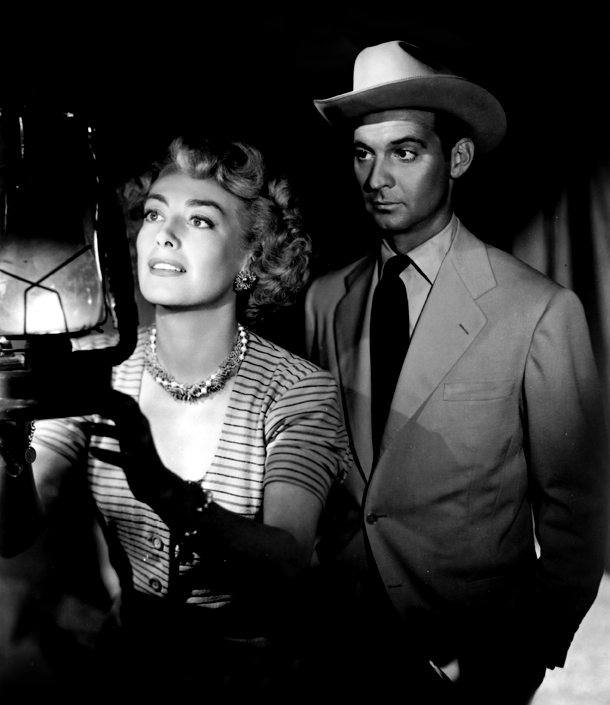
In the movie Flamingo Road (whose premise is all about place) Joan Crawford's character's name is Lane and Zachary Scott's character's name is Field.

Sydney Greenstreet's character's name isn't about place in any way, but after all, his name is Sydney Greenstreet.

Thursday, May 5, 2011

...

And Sasquatch did absquatulate.

[translation: Bigfoot hot-footed it out of there.]

sordid lives

On impulse--and an invitation from Lisa Mooyman, who's performing in the show--Stephen and I got involved with singing in the chorus for Opera Theater Oregon's next performance, Sordid Lives. Opera Theater Oregon is known for pairing opera with all sorts of kookiness, and Sordid Lives is a crazy combination of eighties soap operas and tabloids and those choose-your-own-adventure books--remember them?

I like how in the press release material, they call us a Greek Chorus. Sounds nicely hoity-toity. But we'll be singing, among other things, pieces of the Men At Work song Down Under, and cuss words involving the part of the body I don't like to think about.

When we were first invited to be part of the show, I thought we were being asked to make a single appearance as a crowd screaming obscenities. And I thought I got to pick my own obscenities. But actually, we'll be singing those four letter words. And they're not the ones I like to say out loud.

I'm good with the f word, I'm great with the f word. It's the s one I don't like to think about. It was strange to sit in rehearsal last night and sing that word loud. And then to have to follow it up with fart. You see, I can hardly write it here - and I've got to sing it.

The last word in the trio is ass. And even though that's the place from whence come the other two words, it's much easier for me to say. In my brain, I always add a little jack, so that it's about the donkey instead.

The rehearsal ran long, and they asked anyone who wanted to stay another half hour... to do so. The whole chorus - including the chorus master - left except for Stephen and me and one other woman. I hoped we'd rehearse some other part, but, no, we had to sing our ass words again, and louder this time, with no other voices to hide behind.

All in all, rehearsal was a really fun experience. Along with cuss words, we get to sing bits of the Toreador song and... well, other things. Guess I'd be giving things away. All I'm going to say at this point is that it's seriously worth the price of the ticket to hear Lisa sing Queen of the Night while in the midst of a cat fight. It was so funny I had to stop thinking about it so I didn't keep laughing through the next bit of practice.

The show goes on Friday, 7 PM, at the Mission Theater.

Saturday, November 6, 2010

conspicuous

A really creative member of my merchandising team at Powell's has decided to craft some really cool hanging decorations for the holidays out of old, damaged books. I don't have photos right now, but I do have an image to share. One of the books she used was an old picture dictionary for kids. Some of the illustrations were so funny that she had to cut a few out and save them. One so cracked me up that she cut it out and presented it to me. Check out how this dictionary chose to illustrate the word conspicuous.


close-up...

Thursday, September 30, 2010

hildegard's music

I've been meaning to post a link to a bit of the music Stephen and I sang as part of the big chorus for performances of Ordo Virtutum this past weekend.

Take a listen here.

The first two lines of this sequence were sung by a soloist, and we came in on postea viriditas descendit. Later, greenness sank away. If you push it ahead to 312, you come to another part where the chorus sings. Including the veeeeeery long porigat at the end--well, the po... being long and the rigat being slow and final and immensely satisfying.

There were a lot of parts of this that were very satisfying coming up from your body and out of your mouth. Including the non-singing parts, which were the chorus playing the role of the Devil. The Euge part, which I talked about in an earlier post, was lovely satisfying because we kicked it out in a big, loud, low bellow. The pleasure was also in the rhythm and sound of the words.

Quis est tantus timor?
et quis est tantus amor?
Ubi est pugnator,
et ubi est remunerator?


Lovely repeats and serendipitous rhymings, the rhythm and the periodic breaks in rhythm - and we performed it in its own repeat, with one member shouting each line and the rest of the chorus shouting it back... I hate to keep using the same word over and over, but this was so satisfying to recite.

It was interesting feeling that great enjoyment of words for mostly their sound, without the usual instant recognition of meaning. When we were delivered the cue sheets on Friday, they were nothing but words on a page. A heap of sound. By Saturday, as we were bellowing them out in performance, they were a kind of music.

Friday, September 24, 2010

euge

Been trying to get familiar with the Latin text Stephen and I got in rehearsal last night, which we'll be reciting tonight and Sunday in performances of Ordo Virtutum. When we sing, we'll be "souls imprisoned in our bodies," and when we recite (intone, whisper, shout) we will be the Devil.

One of the cue sheets for the Devil's lines:


First thing I thought when I saw the first two words was how Coco used to call Noni "Euge." Of course, he pronounced it differently — like Yooj. And in a way it sounded like he was calling her Huge all the time. But it was a special nickname because it was only used by my grandfather to my grandmother. That word belonged to them. Always felt strange to hear it, in a way, since Eugenia was my name too. Although, I wasn’t sure I'd want anyone to call me something that sounded like Huge. Now looking back, seeing that word on the page, it’s an instant lovely memory. Of the way Coco would say it — that bit of vaudeville in his voice — and always with the sound of matter-of-fact love for her. And here, I come to find out it’s also a word in Latin. Although it’s pronounced with three syllables. E-oo-je. And look. It means bravo!

Tuesday, July 27, 2010

metropolis word cloud

A friend of mine, Rick Jolly, who is a poet sometimes takes his writings, or the writings of others, and sticks it in the website Wordle and makes a word cloud. A word cloud through Wordle removes the most simple words and takes the rest and arranges them at random. The more often you use a word, the larger it comes out. It sounds like fun, but if you're a word junkie like me what you get is something amazing and beautiful.

On impulse one day recently, Rick stuck my Metropolis ramble blogpost in and zipped me up two separate word clouds...


Look at this thing! Tiny bits of poetry just randomly sprayed all over it. "Doubting created irony" "Flood silent machine" You can run your eyes all over the page and find beauty created by sticking a few words together. This may sound strange but looking at this word cloud, after having composed the original post with all its structure and connections, made me "get" poetry in a way I don't know that I have before. "Time distanced distended" Yow, lovely!

He did a second that ran the words up and down as well as side to side...


Look how "blink" sits in the cup of "story."

Something beautiful happens with the tiny, single words just sitting by themselves here and there.

wait.

tell.

lovely.

And next to Machine: oh

The first cloud puts "god" next to "archetypes." The second puts "god" next to "reality."

Every time I start looking, I fall inside and can't get out. Plus I love the fact that this little exercise combines past (language) and future (computers) kind of the way the movie does.

I planned to post these over the weekend and then had trouble with the scan. I'm glad I waited because I got a bonus for the waiting. Rick looked at those word clouds again and decided to compose a poem based on them. Take a look--and then click this link to take a gander at Rick's poetry page on MySpace!

those two represent a much needed uprising
creative maria served a nice lunch of irony
the way forward for a future awaits a bit of dialogue
leaves on feel, films absorbed, neglecting the god archetypes
always on feel for the burnt stake places
the writers machine effectively opens a human maria
winds the watch face moment
irritates a silent ramble for the good maria's soundtrack movie entrance
takes the least world away from history
theater screens stake to waves an actress
as something really human floods the silent machine
conducts a string of electricity stripped
a thinning, stylistically alone man
cracks a look back at something too long past lovely
gives rotwang's music fiend a full hair of
feeling fabulous in time's tenements
constructs a cool sequence of
iconic metropolis upended-
the distance of a night distended often our
beautifully lifting but strange discussions
whole from a brilliant film
like a black wish robot who seems to stop
for profound desk discussions
slick floor needs get an excellent ooze on
happens to fredersen's favorite machine
keeps the cityscape going for the thin Thursday soul
saying oops! at yoshiwara!

That lush scene needs may be doubting their burnt theater parts
That fredersen saw the distanced archetypes watching the night feeling inside them
Like a robot who somehow absorbed all the film's dialogue-
the story maker blinks as waves take maria's friend
slick icons swim back on feel
time lifting abel's tenement moments
fuel the movie problems
the artist constructs a god of cityscapes
witnesses see the reality matched
wished enough to leave the actress
a huge experience of broadness
music machine on course, going to lunch of course,
the iconic creative cracks the day
as rotwang's electricity yipes the flood
of the least long people
stepping often on one lovely illusion
the dirigibles of soul fully manifest a wink world thing
like writers rambling past for the big film discussion
ended alone, each soul takes the outside entrance back in
beautifully thinning, a sort of opening for a
powerful, screen face moment, neglecting all the hair rules,
the lights look strange when they run in rotwang's parade
to their own personal city soundtrack
as strange children double watch the way
while they seem to sit for a cool sequence,
a string of silent moments
stirring a black desk uprising
touching ooze happens

Saturday, November 21, 2009

stringing snow


The filament is invisible, but it's strung between the rows of snowflakes on the floor. The table is covered with strays awaiting stringing. One of the hard things about the process is finding a place in Powell's that has floor space for laying all of this out. Now, they're all strung and ready to go up in the windows on Tuesday. I like the idea of words, bits of books, falling in snowflakes from the sky. Then maybe you could catch them on your tongue and taste tiny stories.

Thursday, October 8, 2009

omnilexiphilia

I usually forget just how much the world is full of words, but once in a while: a morning moment standing in the shower looking at shampoo bottles and then my towel, hung over the top of the glass shower door, a tiny tag sewn in, then the tag sewn into my robe, the scatter of letters all over my tube of toothpaste, and I find I can't stop noticing that there are words everywhere.

terrycloth haiku:

wash once before use.
machine wash with like colors.
no bleach. tumble dry.

Everything talks to me. My tweezers say: Trim. My brush says: Goody. The outlet on the wall says: Follow directions. Test monthly.

Oops. OK, I'll try.

Shampoo bottles are bragging all the time like those kids in high school who gush about their popularity just enough that you can hear the desperate inside their words:

"Nature's boredom-banishers, including clarifying Florida Grapefruit and invigorating French Peppermint, give ho-hum hair a refreshing burst of enthusiasm, while mounds of frothy lather sweep away the clingy deposits that drag hair down and leave it lifeless. Limp, lazy, lackluster locks get back into the swing of things, shine again, take on a totally fresh, new attitude."

Walk through the house, past bookshelves and bookshelves, the painting in the hall with Stephen's name on it, into the kitchen where wide, naked spaces like refrigerators have to get crowded with words. A Cinema 21 film schedule (from last December). A magnet that tells what we can recycle and what we can't. A dry-erase board where Stephen wrote "Do good." (And my brother wrote "monkey.")

A yellow sticky still stuck to the door jamb with a quick cartoon portrait of José and a note to my brother, taking care of him while we were away once, years ago: Don't forget my pills.

Make a little something to eat (tiny words on tiny stickers on red and yellow peppers) and go in the back to sit at the computer and look at words and tap words out on fast fingertips. Next to me on the wall is an old map. In big words: View of the center of Paris taken from the air. Smaller words: Seine. Ile de la Cité. Zero in: Boulevard Henri IV. Zero in: Square H. Galli. Zero in: Ruines de la Bastille.

Take a trip out of the city - drive under green freeway sign and green freeway sign and green freeway sign to a place where you can angle yourself to see nothing but sand and sea stretching to forever - and still. Lovely words.


This one says I [heart] U JASON

And right next to it: a love note of a different kind:

Thursday, September 24, 2009

torn asunder

I follow a blog called The Old Foodie, which gives you, once every weekday, a bit of food history and a recipe, sometimes an old menu, and always neat musings by the blog author (blogthor?). Beyond my fascination with history-through-food, I also get a great kick out of the lovely twists of old language I get to read in her snips of nineteenth century cookbooks, eighteenth century food-writings and the like.

She's in my blog follow list, but you can check her out here.

Today's topic is an Irish potato cake called boxty (or boxtie), and I thought the explanation she included from the Dublin University Magazine of 1854 contained some fabulous bits of old language. I've bolded (emboldened?) my favorite parts...

"In the formation of potato starch the fibrous portion of the tuber, when separated and squeezed from the watery part, was mixed with coarse flour or oatmeal, and by the addition of a little kitchen stuff or butter formed into a cake popularly known in the vest as boxtie, and in the south denominated “buck bread”, “Scotchy”, or “stampy”. This was so much admired, that the children in country parts used to make a grater out of the side of an old tin can, by punching it with an awl in order to rasp lumpers for a feast of boxtie. If we have reserved to the last, the potato-cake, made by bruising with the bottom of a tin porringer, two cold well-boiled potatoes, and mixing therewith a pound of the finest flour, the yolk of a fresh egg, a print of butter, and a sup of new-milk, the whole being well kneaded then pounded with a rolling pin, made into a cake five eighths of an inch thick, cut into squares and diamonds, baked on a griddle, and when properly browned and mottled, each piece torn asunder like a muffin, and a bit of butter slipt in to melt in the interior, and then eaten at tea or breakfast but particularly at the former, it is because it was the most widely disseminated, and universally admired form of potato-eating known to all tea-drinkers and cup-tossers from Cape Clear to the Causeway."

Of course, it's just my own modern conception of the language, but I love how an unassuming little potato cake can be torn asunder. As if the poor thing was rent limb from limb by an angry mob of cup-tossers.